JPM Healthcare 2026: Why This Year’s Coverage Drove Real Influence—Not Just Headlines
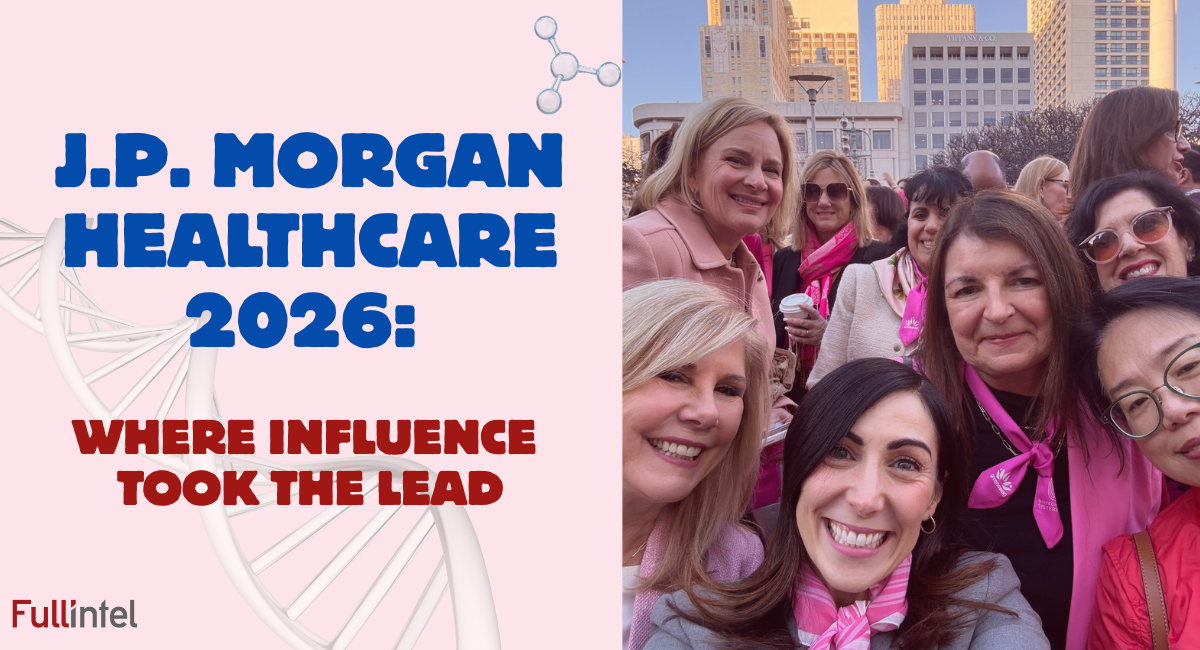
Every January, the JPM Healthcare Conference sets the tone for the year ahead in pharma and biotech. It’s where strategy meets scrutiny—where investors, analysts, media, and stakeholders look for credible signals about pipelines, leadership, innovation, and long-term growth.
This year, I experienced JPM in person for the first time—and it reinforced just how much influence now travels beyond the headlines themselves.
At Fullintel, we analyzed earned media coverage from JPM 2026 conference to understand not just how much coverage JPM generated, but how effectively it reached and influenced audiences across today’s dominant information channels: AI-powered search outputs and social platforms.
The Reality Check: Audiences Don’t Consume News The Way They Used To
Senior communications leaders already know this, but JPM provided a clear case study of the shift:
- AI-generated search outputs (including ChatGPT and AI Overviews) increasingly shape what people see—often without a click.
- Social platforms remain a primary news source, with roughly seven in ten people getting information there.
- Traditional reach and impressions alone no longer predict impact (they never really did).
That’s why this analysis focused on influence signals, not volume alone—looking at which stories were positioned to surface in AI systems and which narratives traveled through social networks.
The Headline Finding: JPM Coverage Traveled Where Influence Happens
The results stood out—especially when benchmarked against broader industry performance:
- 57% of JPM-related coverage appeared in outlets likely to be prioritized by AI systems
This is nearly three times higher than what we typically see across healthcare and life sciences, where AI-eligible coverage often falls below 20%. - 50% of coverage was shared and engaged with on social media
Industry averages for news content tend to hover closer to 30%, making JPM’s amplification unusually strong.
Taken together, this means that more than half of JPM coverage was positioned to influence audiences through AI-generated answers or social feeds—not just traditional article consumption.
That’s a meaningful shift from exposure to impact.
Why This Matters For Pharma And Biotech Communicators
From a communications perspective, JPM 2026 reinforced several critical realities:
- Influence is now predictive, not retrospective
Coverage that surfaces in AI outputs or gains social traction is more likely to shape understanding, trust, and decision-making—even if audiences never click through to the original article. - Credible narratives outperform volume
Topics that performed best—such as pipeline execution, GLP-1 competition, regulatory readiness, pricing dynamics, and AI-enabled innovation—were anchored in credible spokespeople, clear announcements, and substantiated claims. These are precisely the signals AI systems and social audiences reward. - Executive visibility still matters—but context matters more
CEO and senior leader commentary from companies like Merck, Novo Nordisk, Eli Lilly, Sanofi, and AstraZeneca drove outsized impact when paired with clear strategic framing and tangible business signals, rather than speculative storytelling.
A Modern Measurement Lens For Flagship Moments
JPM 2026 underscores why communications measurement must evolve alongside audience behavior.
At Fullintel, we increasingly view moments like JPM through a predictive measurement lens, incorporating:
- Media Impact Score (MIS) to assess overall influence
- AI-source penetration to understand future visibility in generative systems
- Social amplification to track narrative velocity
- Sentiment, reach, and topical alignment to ground insights in context
This approach provides a more realistic view of which narratives are likely to endure—and which will fade—once the conference spotlight moves on.
The Takeaway For Senior Leaders
JPM Healthcare remains one of the most important communications moments of the year. But its true value no longer lies in how much coverage it generates.
It lies in how effectively that coverage travels through AI systems and social platforms—where audiences increasingly form opinions, build trust, and make decisions.
For pharma and biotech communicators, the implication is clear:
Success today is not just about being present at marquee moments like JPM—it’s about engineering narratives that are structured, credible, and positioned to influence across modern information ecosystems.
And that’s a shift worth measuring.

Angela is VP of Insights at Fullintel—a media intelligence company that specializes in news monitoring and analysis. She has worked in media measurement for 15 years, helping brands improve business results through data-driven, actionable insights. From public relations agencies like Lippe Taylor to media research firms like PRIME Research, she has consulted across industries, particularly healthcare and pharmaceuticals. She has presented and published several award-winning research papers about news content that drives recall, engagement, and brand trust. Her “Trust in Pharma” research outlines how biopharma brands can build and sustain trust.
She contributes knowledge at the intersection of academia and practice as director of the International Public Relations Measurement Commission and as a member of the International Public Relations Research Conference Board. Her contributions have been recognized with multiple industry awards, including PRNEWS People of the Year (Data & Measurement Game Changer), PRNEWS Top Women (Industry Champions), and AMEC Rising Star for innovation in communication measurement.