
The PR Measurement Framework for the AI Era: Moving Beyond Impressions
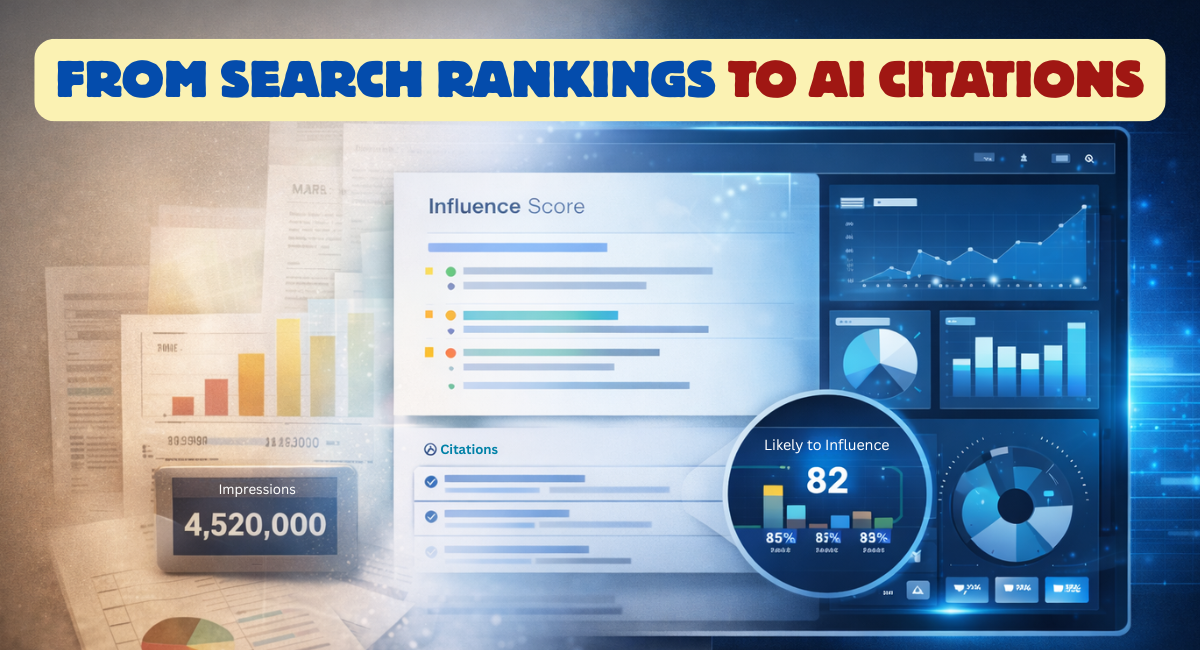
Traditional PR Metrics are Breaking Down – Here’s a New Approach To Help Capitalize on AI Search
I’ve spent a lot of time over the past 15+ years counseling clients on how to conduct accurate media analysis to drive successful PR strategies.
But the PR landscape is rapidly shifting under all our feet. As that happens, I’ve found that comms professionals are more unsure than ever about how to measure success – especially as AI search, zero-click behavior, and automated summaries reshape how their audiences consume information.
That’s why PR measurement in the age of AI requires a new approach, always building upon best practices and science-based principles. This article introduces a modern, four-step measurement framework built for the AI era. It connects media performance with AI visibility, human behavior, and business outcomes, hopefully helping answer the questions leaders are actually asking along the way.
Why Traditional PR Metrics Are Breaking Down
Let’s be honest: Impressions have never been a great way of measuring success. I’ve always recommended a combination of quality and quantity metrics linked to goals and objectives–taking us beyond impressions.
But as users encounter AI-generated summaries in search engines – or just skip that step completely using generative AI search – the role of traditional media is shifting, and some metrics have become borderline unusable.
The Media Landscape is Changing
It’s not your grandmother’s media landscape anymore. In fact, it’s not even the same as it was just a couple of years ago. The media landscape is changing fast, with social media continuing to gain ground as a main source of information for many as people seek content from those they trust: A 2025 Reuters poll showed that social media surpassed television and online news as Americans’ top news source for the first time.
Print and radio coverage, meanwhile, now has minimal impact. Digital sources are the most prominent sources of news consumption, and because people get their information from social channels and AI search engine outputs, we need to meet our audiences there.
AVE Was Always Flawed, and Now We Can Clearly See It Is Entirely Disconnected
Advertising value equivalency (AVE) is, without a doubt, the most maligned metric in the PR business, and for good reason – while it attempted to equate earned and paid content, the logic never made sense.
But as AI platforms surface information without ads or even website visits, AVE has become completely divorced from reality.
Zero-Click Behavior: More than 60% of Readers Don’t Click Through to Source
More than half of search queries now end without a clickthrough to the actual source. Audiences increasingly consume summaries, snippets, or AI answers instead. In a recent Columbia Journalism study, zero-click searches were found to be up to 69 percent.
That means that even if your brand and key messages have impacted perceptions and driven valuable coverage, you wouldn’t know it if your analysis is governed by traditional volume, reach, and click metrics.
The Four-Step PR Measurement Framework for AI-Powered Search
So what’s the point of getting media coverage at all in the age of AI search?
Turns out, quite a bit: According to a UConn-Fullintel analysis to be presented at the International Public Relations Research Conference (IPRRC) in March, PR teams are in an excellent position to capitalize on the growing use of AI search engines. That’s because news articles remain heavily weighted in AI algorithms, as they are deemed more objective, authoritative, and accurate than other sources of information. As such, news content significantly influences AI-generated responses. AI systems help amplify quality news coverage, reaching more eyes and making media relations as critical as ever for shaping public perception.
But measuring impact in the AI era remains a huge challenge. That’s why I’ve created this four-step framework, aligned with best practices like the AMEC framework, that you can use wherever you are on your measurement journey. These steps can help you better prove value and improve performance by using AI PR metrics and integrating human and AI elements.
1. Measure Your ‘Share of Model’ With GEO
Similar to SEO, generative engine optimization (GEO) is part of modern PR measurement. It can help measure how your brand or initiative appears in response to prompts in AI search engines like ChatGPT or Google Gemini.
While the science is still a bit fuzzy around this, PR practitioners can use GEO techniques to measure a brand’s share of model, similar to tracking share of voice in traditional media. Here’s one way to do it:
- Create a series of personas – essentially, long prompts describing in detail your different audiences.
- For example, “a 42-year-old, white female who is concerned about family history of type 2 diabetes. She wants to lose 40 lbs for health and longevity, not just aesthetics. She’s research-oriented, skeptical of miracle fixes but open to doctor-recommended options. And she balances cost with long-term health value.”
- Run a series of prompts that this persona would likely ask in a search or generative AI engine (you can ask AI to help create the prompts, or look at Google search questions). To control for bias from your own search history, use an Incognito browser, or you can use a tool like ScrunchAI or Profound.
- After running searches with different combinations of personas and prompts, you’ll get a sea of information you can analyze for factors like share of model.
There are obviously a few flaws with this approach. First off, it’s not real – even though it’s meant to be a close approximation. Second, the reality presented could vary wildly based on each organization’s prompts. After all, it’s nearly impossible to create all the nuances of our realities with just an AI prompt.
But this approach can still help you understand what’s more likely to reach and influence key audiences in AI models – and how you can tailor your content and outreach strategies to match those findings.
💡Note: AI models love clear sourcing, bullet points, structured subheads, timestamps, and authoritative quotes. Make sure to include this kind of formatting in your owned content to increase the chances of it being picked up by LLMs.
2. Focus On Sources More Likely to Appear in AI Engines
It’s now vital to consider which outlets are more likely to get cited in an AI search engine output. The good news is that we can predict through research which outlets are more likely to get picked up in certain industries, with outlet credibility being a major factor.
You can use a tiering model in your analysis to ensure you prioritize media sources more likely to show up in AI search:
- Tier 1: The publication has a deal with one or more large language models (LLMs), and regularly feeds data into the models.
- Tier 2: There is no deal, but it’s obvious the models have collected training data based on the outputs of these publications.
- Tier 3: No data is being collected by LLMs because they’re blocking ingestion or suing for copyright infringement.
The Fullintel-UConn study mentioned earlier showed that LLMs prioritize citations from what are viewed as “credible” outlets – those that, by and large, report the news objectively. Along with news sites, this can also include third-party credible sources such as university and association websites.
3. Measure AI Engine Coverage Impact With Predictive Metrics
Measuring the impact of coverage in the AI era isn’t just about volume, however. It’s about the quality and type of coverage more than ever before. In our research, we’ve found that many of the same things that influence humans also influence LLMs, which is why measuring coverage quality has become even more important in the age of AI.
While outlet is a key factor, there are other quality factors that go into this equation as well, and are taken into account in deep metrics like Fullintel’s Media Impact Score (MIS).
- The MIS uses a series of inputs across three buckets – recall, audience (including social shares), and perception – to predict how likely news coverage is to influence audiences (and AI engines, as well).
- The factors that inform MIS have been shown to lead to perception or behavior outcomes.
- We’ve found that two factors seem to carry the most weight with AI: outlet tier and the inclusion of credible voices, such as quotes from doctors or researchers. So we typically give these factors a bit more weight when using MIS to measure AI impact.
As an aside, I always tell clients to look at a quality metric (like MIS or sentiment) next to a quantity metric (like share of voice). This helps provide context through comparisons over time and against competitors for any metric.
4. Measure Reputation Using a Combination of AI and Human Intelligence
My last measurement recommendation is to measure brand reputation and any other outcomes, typically through a survey – and then tie those measurements to organizational goals, such as increasing sales or market share.
While reputation measurement and surveying are all about what humans think, we can use AI to provide a more frequent pulse of our audience’s perceptions and attitudes, while allowing for course correction along the way.
- You can use AI to predict how certain audiences will likely respond to certain messages. Do this by creating a synthetic or proxy audience or persona, or an AI-generated model of a target group, similar to what we did earlier.
- However, surveys still matter with real audiences to understand a better picture of reality (or perceived reality). Surveys can help identify trends and confirm reputation or trust results.
All the elements I’ve mentioned here are important for triangulating brand influence. This approach can boost your comms measurement and guide your PR strategy in the age of AI by combining technology and human curation.
The Human-AI Balance in Measurement
AI offers speed and scale, but accuracy and judgment still require humans, which is why a balanced measurement approach is required even in the age of AI.
In our research, AI reached just 59 percent accuracy in coding articles for sentiment, compared with 85 percent for trained human analysts. At the same time, however, AI achieved coding speeds of 100X that of humans, allowing for a 40 percent faster analysis completion.
The lesson is clear:
- AI does certain things well, such as identifying patterns across large datasets, extracting recurring themes, creating quick summaries, and accelerating reporting workflows.
- Humans must be involved to interpret nuance, tone, and implied meaning; assess risk and credibility; connect insights to business strategy; and catch anomalies that models can easily overlook.
In other words, PR teams should continue to use humans where accuracy matters most, and consider using AI where speed and scale are crucial.
The Preferred Measurement Approach: Automation + Human Curation
In many cases, AI can help scale a measurement project faster by quickly taking care of easier tasks while still achieving high levels of accuracy, leaving humans a smaller amount of more specialized work requiring more nuance.
The most effective measurement programs use a balanced approach: AI for acceleration and humans for interpretation.
Conclusion: The Shift From Counting Coverage to Leading Measurement Strategy
PR professionals, like many, want to know what the advent of generative AI means for them – and how they can best capitalize on the new technology by moving beyond AVE measurement and other antiquated approaches. To start, it’s important to move beyond output tallies and other traditional PR metrics, which are inadequate in an age of AI summaries and zero-click searches, where focus is on influence, not volume.
What You Can Do This Quarter
To fully understand how information flows across AI platforms and how you can measure your brand’s visibility in AI search, our four-level framework provides a structured way to align communications efforts with technological, behavioral, and business outcomes by:
- Measuring your “share of model” by conducting an AI visibility audit
- Focusing on sources most likely to be cited in AI engines using outlet tiering
- Using predictive quality metrics to score AI engine coverage impact, penetration, and credibility
- Combining AI and human intelligence to measure reputation and connect communications data to business outcomes
Communicators are ready for a sharper, more defensible measurement model – one that reflects today’s information ecosystem and supports strategic decision-making at the executive level.
- AI search visibility
- AI-generated summaries
- automated AI summaries
- communications measurement model
- Human and AI collaboration
- hybrid AI-human model
- no-click search behavior
- PR measurement for generative search
- PR measurement framework
- PR measurement in the AI era
- visibility in generative search
- Zero-click search

Angela is VP of Insights at Fullintel—a media intelligence company that specializes in news monitoring and analysis. She has worked in media measurement for 15 years, helping brands improve business results through data-driven, actionable insights. From public relations agencies like Lippe Taylor to media research firms like PRIME Research, she has consulted across industries, particularly healthcare and pharmaceuticals. She has presented and published several award-winning research papers about news content that drives recall, engagement, and brand trust. Her “Trust in Pharma” research outlines how biopharma brands can build and sustain trust.
She contributes knowledge at the intersection of academia and practice as director of the International Public Relations Measurement Commission and as a member of the International Public Relations Research Conference Board. Her contributions have been recognized with multiple industry awards, including PRNEWS People of the Year (Data & Measurement Game Changer), PRNEWS Top Women (Industry Champions), and AMEC Rising Star for innovation in communication measurement.
