When Doing Good Isn’t Enough: What New Research Reveals About Disaster Relief, Reputation, and Public Motivation
When a crisis strikes, organizations often step forward to help. But here’s a question communicators rarely stop to ask:
Do disaster relief efforts actually motivate the public—or do they mainly strengthen reputation?
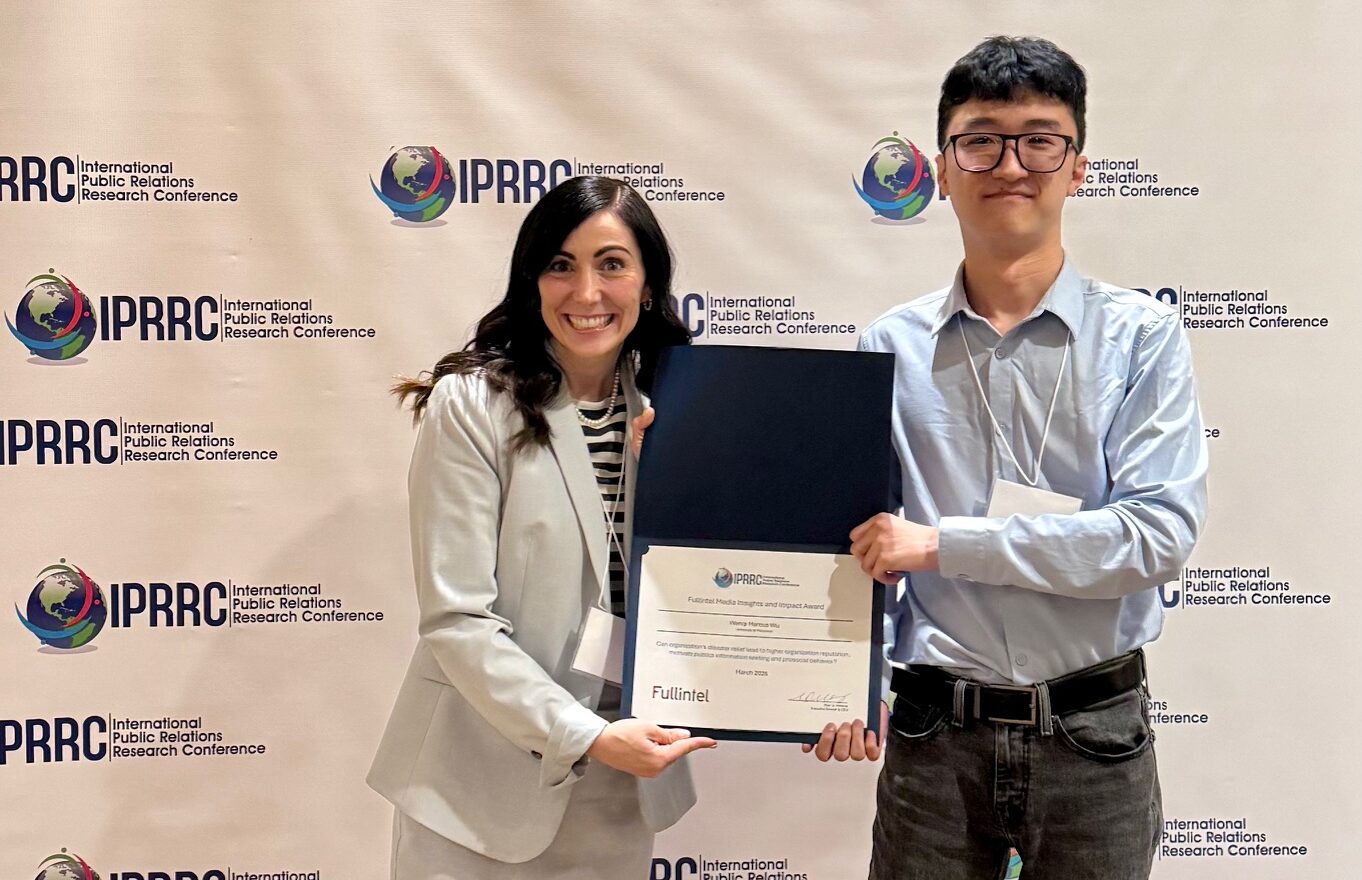
That distinction matters more than ever in a communications landscape defined by limited attention, growing skepticism, and rising expectations for corporate responsibility. At this year’s International Public Relations Research Conference (IPRRC), emerging scholar Marcus Wu, a Phd student at the University of Maryland, explored this question in a study that offers practical insights for communicators navigating crisis response and corporate social responsibility.
Wu received the Fullintel Media Insights and Impact Award, a $1,000 honor recognizing research that delivers actionable insights and advances the practice of communications measurement. His study examines how audiences respond to disaster relief efforts from for-profit corporations versus nonprofit organizations, and what those responses mean for reputation, engagement, and public motivation.
The results challenge some common assumptions—and provide clear guidance for PR professionals.
Why IPRRC Matters for the PR Profession
For more than 25 years, the International Public Relations Research Conference has served as a unique bridge between scholars and practitioners.
Unlike traditional conferences where attendees sit through slide-heavy presentations, IPRRC is built around small-group roundtables where research is presented and debated in real time. Scholars share new findings. Practitioners challenge assumptions. The result is research that directly informs communications strategy.
That practitioner relevance is exactly why Fullintel created the Media Insights and Impact Award: to recognize research that helps communicators measure and demonstrate the real-world impact of their work.
Marcus Wu’s study is a strong example.
The Research Question: Do People React Differently to Corporate vs. Nonprofit Relief?
During the 2025 California wildfires, both corporations and nonprofits mobilized relief efforts. Companies like Toyota and Hilton provided assistance ranging from temporary housing to financial support, while nonprofit organizations focused on humanitarian aid and community support.
Wu’s research asked a simple but important question:
Do audiences interpret these actions differently depending on who provides the aid—and how it’s delivered?
The study draws on two well-established communications frameworks:
- Social signaling theory, which suggests that organizational actions send signals about values and intentions.
- The Situational Theory of Problem Solving, which explains how people recognize problems, seek information, and decide whether to take action.
Together, these frameworks help researchers measure not just reputation effects, but whether communication efforts actually motivate engagement.
As Wu explained in the study:
“Individuals view for-profit and nonprofit organizations through two very different lenses. A for-profit company contributing to relief efforts is perceived as exceeding expectations, substantially boosting its public image. A nonprofit doing the same work is often seen as simply fulfilling its mission.”
That difference in expectations turns out to be critical.
How the Study Worked
Wu conducted a 3 × 2 experimental study examining how people respond to disaster relief efforts from different organizations.
Participants read a real news article about the California wildfires along with a fictional organization’s response to the crisis. The scenarios varied across two factors:
- Organization type: for-profit corporation vs. nonprofit organization
- Relief strategy: high-fit aid, low-fit aid, or cash donations
High-fit aid referred to contributions aligned with an organization’s core capabilities—for example, a hotel chain providing free rooms during an evacuation. Low-fit aid involved unrelated products, while cash donations represented a widely accepted but less distinctive form of support.
A total of 163 participants were randomly assigned to one of the experimental conditions. After reading the scenario, they completed a questionnaire measuring several outcomes, including:
- Organizational reputation
- Word-of-mouth intention
- Problem recognition
- Situational motivation
- Prosocial behavioral intentions
The goal was to understand how different relief strategies influence both perception and engagement.
Key Finding #1: Corporate Relief Efforts Boost Reputation More
One of the most striking results: for-profit organizations received significantly higher reputation scores than nonprofits when they engaged in disaster relief.
Why?
Because audiences interpret the actions differently.
When a corporation donates, audiences often see it as going above and beyond expectations.
When a nonprofit donates, audiences see it as part of its mission.
Both responses are positive—but the reputational lift is stronger for corporations because the action signals sacrifice and voluntary contribution.
Research from the Institute for Public Relations has similarly shown that stakeholder expectations strongly influence reputation outcomes.
Key Finding #2: “High-Fit” Donations Create Stronger Engagement
Not all donations are perceived equally.
Wu’s research found that high-fit aid—contributions aligned with an organization’s expertise—generated stronger public motivation, particularly when delivered by for-profit organizations.
Examples include:
- A hotel chain providing shelter
- A logistics company delivering supplies
- A pharmaceutical company donating medicine
These actions signal that the organization is mobilizing its capabilities, not simply writing a check.
Wu explained:
“If organizations are donating their strengths or their products, it shows they care more than donating unrelated products or cash. High-fit contributions signal that the issue is important.”
For communicators, that signal can make the difference between a story that resonates and one that fades quickly.
Key Finding #3: Donations Don’t Automatically Inspire Public Giving
Another surprising finding: seeing organizations donate did not significantly increase individuals’ intention to donate themselves.
This challenges a common assumption in corporate social responsibility campaigns—that visible giving automatically inspires additional giving.
Instead, relief efforts primarily influenced reputation and awareness, not direct behavioral imitation.
For PR measurement, this is an important reminder: reputation, awareness, and behavior are different outcomes and should be measured separately.
Frameworks such as those developed by the international measurement organization, AMEC, emphasize linking communications activities to distinct outcomes like trust, awareness, and action.
Wu’s research reinforces the importance of that structured approach.
Key Finding #4: Nonprofits Maintain a Trust Advantage
While corporations benefited from a stronger reputation boost, nonprofits held an advantage in baseline trust.
Participants were more likely to trust nonprofit organizations and support them in advocacy or policy-related efforts.
That suggests a different strategic role for nonprofits in crisis communication:
- Corporations may gain reputational capital from relief efforts.
- Nonprofits may be more effective at mobilizing advocacy and systemic change.
As Dr. Tyler Page, Associate Professor at the University of Connecticut and mentor to Wu said:
“Research like this helps practitioners understand that reputation, trust, and motivation are not interchangeable outcomes. Each type of organization begins with different expectations from the public, and those expectations shape how people interpret their actions.”
Practical Guidance for Communicators
So how should PR leaders apply these insights?
1. Align Relief Efforts with Your Strengths
When responding to a crisis, start with a simple question:
What capabilities can our organization uniquely contribute?
High-fit contributions send a stronger signal of commitment and authenticity.
2. Understand the Expectations Gap
Corporate and nonprofit organizations operate under different public expectations.
For corporations, relief efforts may exceed expectations and boost reputation.
For nonprofits, the same action may reinforce trust rather than elevate reputation.
Recognizing that difference helps communicators set realistic goals and measure outcomes more accurately.
3. Build Awareness Before a Crisis
One of Wu’s most practical insights is that relief communications are only effective if people already understand the issue.
If audiences lack awareness of a crisis—or don’t see it as relevant—relief efforts may have limited impact.
This is particularly relevant in areas like climate change, science communication, and public health.
Communicators should invest in ongoing issue awareness, not just crisis messaging.
4. Monitor and Adapt During a Crisis
Disasters evolve quickly.
Organizations that respond effectively treat crisis communication as a continuous process, monitoring public awareness and adjusting messaging as events unfold.
Measurement and media intelligence play a critical role in that process.
The Bottom Line
Marcus Wu’s research highlights an important lesson for PR professionals:
Doing good is important—but how you do it matters just as much.
Corporate relief efforts can strengthen reputation, particularly when organizations contribute their core capabilities. Nonprofits maintain trust advantages that position them to drive advocacy and systemic change.
And across both sectors, the most effective communication strategies begin long before the crisis—by building awareness, understanding expectations, and measuring impact.
Because in today’s complex information environment, communications success depends not just on action, but on understanding how that action is perceived.

Angela is VP of Insights at Fullintel—a media intelligence company that specializes in news monitoring and analysis. She has worked in media measurement for 15 years, helping brands improve business results through data-driven, actionable insights. From public relations agencies like Lippe Taylor to media research firms like PRIME Research, she has consulted across industries, particularly healthcare and pharmaceuticals. She has presented and published several award-winning research papers about news content that drives recall, engagement, and brand trust. Her “Trust in Pharma” research outlines how biopharma brands can build and sustain trust.
She contributes knowledge at the intersection of academia and practice as director of the International Public Relations Measurement Commission and as a member of the International Public Relations Research Conference Board. Her contributions have been recognized with multiple industry awards, including PRNEWS People of the Year (Data & Measurement Game Changer), PRNEWS Top Women (Industry Champions), and AMEC Rising Star for innovation in communication measurement.