Oscars 2026 Media Analysis: What the 98th Academy Awards Teach PR Teams About Real-Time Event Monitoring
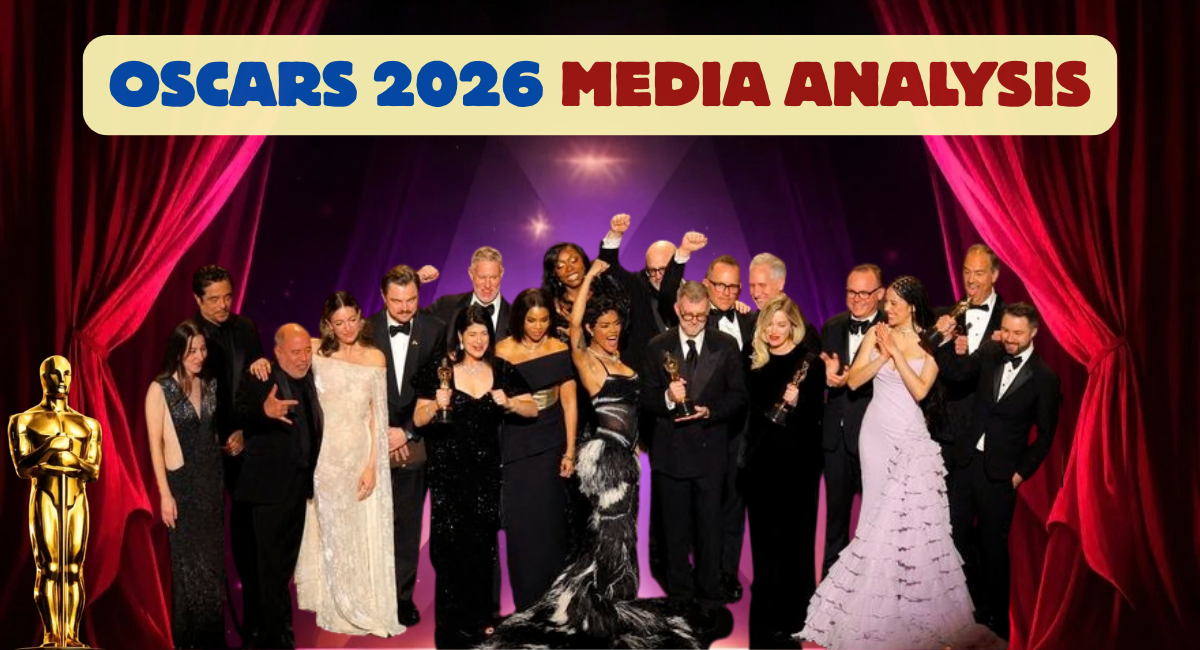
Sinners walked into the 98th Academy Awards with 16 nominations, the most in Oscar history. One Battle After Another walked out with six wins, including Best Picture. The Best Actor race flipped on prediction markets 10 days before the ceremony, generating $48.4 million in trading volume on Kalshi alone. And host Conan O’Brien opened the broadcast by telling the global audience, “These are very chaotic, frightening times.”
That was all before the first award was handed out.
For PR and communications teams, the 2026 Oscars are more than entertainment industry news. They’re a masterclass in how modern event coverage works: how narratives form days before an event, how political statements create parallel sentiment streams during it, and how micro-moments generate hours of social engagement after it. The same patterns apply to product launches, earnings calls, and regulatory announcements. The scale changes. The dynamics don’t.
These coverage dynamics have been building across recent awards seasons. In our analysis of the 2025 Academy Awards media coverage, we saw similar patterns emerge as online speculation and social commentary began shaping narratives even before the ceremony started.
The Major Winners and What They Signal About Coverage Patterns
The ceremony aired March 15 from the Dolby Theatre in Hollywood, broadcast on ABC, and streamed on Hulu. Conan O’Brien returned as host for the second consecutive year. The results split across multiple films rather than concentrating in a single sweep, which created a more complex coverage map than a dominant-winner scenario would have.
One Battle After Another took six Oscars: Best Picture, Best Director and Best Adapted Screenplay for Paul Thomas Anderson (his first competitive wins), Best Supporting Actor for Sean Penn (who was absent from the ceremony), Best Film Editing, and the inaugural Best Casting award for Cassandra Kulukundis. That casting category is the first new competitive Oscar since Best Animated Feature in 2001.
Sinners earned four: Best Actor for Michael B. Jordan, Best Original Screenplay for Ryan Coogler, Best Original Score for Ludwig Goransson, and Best Cinematography for Autumn Durald Arkapaw. Arkapaw’s win was historic. She became the first woman and the first Black cinematographer to win that award. Her speech, calling every woman in the audience to stand, became one of the most-shared moments of the night.
Jessie Buckley won Best Actress for Hamnet, completing a sweep through the Golden Globes, Critics’ Choice, SAG, and BAFTAs. Guillermo del Toro’s Frankenstein picked up three awards. KPop Demon Hunters won Best Animated Feature and Best Original Song. Norway earned its first Oscar with Sentimental Value, winning the Best International Feature award. And two films tied for Best Live Action Short, only the seventh tie in 98 years of the ceremony.
From a media monitoring perspective, distributed wins create a more fragmented coverage landscape. When one film dominates, the narrative consolidates quickly. When wins scatter across six or seven films, every entertainment outlet covers a different angle, social media conversations split across multiple threads, and the news cycle extends as each winner generates its own follow-up coverage.
The Prediction Market Effect: How Narratives Formed Before the First Award
Here’s something that would have been unthinkable five years ago: the most volatile Oscar coverage happened before the ceremony started.
Prediction markets have become a major driver of awards season media narratives. Variety reported that Oscar contracts on Kalshi hit $48.4 million by March 10, up from $29.6 million total in 2025. The Best Actor race showed exactly how these markets shape coverage. Timothee Chalamet was the heavy favorite for the role of Marty Supreme. Then Michael B. Jordan won the SAG Award two weeks out, and Chalamet’s contract dropped from 68 cents to 51 cents overnight. When Chalamet’s comments, which appeared to dismiss ballet and opera, drew backlash on March 6, his odds fell further.
The catch: Oscar ballots had already closed on March 5. The public conversation had completely decoupled from the actual vote. But the media narrative didn’t care. Headlines tracked the shifts in the prediction market as if they were the story.
This matters for any organization running event monitoring. The pre-event sentiment window now creates the expectations against which actual outcomes are measured. When Jordan won Best Actor on Sunday night, the intensity of coverage was driven partly by the narrative drama of the preceding two weeks, not just the result itself. PR teams monitoring product launches, conference announcements, or earnings calls face the same dynamic: analyst expectations and social media speculation create the baseline that shapes how actual news gets covered.
Implementation step: Start your event monitoring window 7 to 10 days before the event, not the day of. Track how expectations form across prediction markets, social media, and trade coverage. That baseline tells you where coverage will intensify after the event, whether results confirm or contradict those expectations.
Viewership Trends and What They Mean for Cross-Platform Monitoring
The Oscars viewership recovery is a data story worth studying. After hitting 10.4 million viewers in 2021 during the pandemic-era ceremony, the numbers have climbed steadily: 16.6 million in 2022, 18.7 million in 2023, 19.5 million in 2024, and 19.69 million in 2025.
Context makes those numbers more impressive. A 2025 Pew Research Center survey found 53% of U.S. adults hadn’t seen a movie in a theater in the previous year. Nielsen reported that streaming accounted for 44.8% of total TV viewership, surpassing broadcast and cable combined. In that environment, the Oscars, with nearly 20 million viewers, is one of the largest non-sporting events on television.
The Academy has also announced it’s moving the ceremony to YouTube starting in 2029, making the show freely available worldwide. That decision reflects a reality every communications team faces: your audience isn’t on one platform anymore. They’re watching on TV, streaming on Hulu, following live threads on X, scrolling reactions on TikTok, and checking prediction markets on their phones. Simultaneously.
For strategic media analysis, the lesson is clear. Single-platform viewership metrics undercount actual engagement by a wide margin. Effective event monitoring requires tracking conversation velocity across broadcast, streaming, social, and emerging platforms simultaneously. The total footprint of the 2026 Oscars is far larger than any one viewership number suggests.
When an Awards Show Becomes a Political Event: Parallel Sentiment Streams in Real Time
The 2026 Oscars leaned into political commentary more than any recent ceremony. That created a real-time case study in how a single event generates multiple, distinct sentiment streams that standard volume tracking would miss.
O’Brien opened by acknowledging “chaotic, frightening times” before pivoting to optimism about film. His joke about broadcasting from the “Has A Small Penis Theater” generated an immediate social spike. Presenter Jimmy Kimmel drew a direct line between free speech threats and broadcast license pressure, quipping about countries whose leaders don’t support free speech: “North Korea and CBS.” The reference pointed to the Skydance-Paramount merger concessions and the cancellation of The Late Show with Stephen Colbert. Javier Bardem stated, “No to war, and free Palestine,” while presenting the international feature category.
The documentary winners pushed further. The co-director of Mr. Nobody Against Putin used his speech to draw parallels between Russian authoritarianism and broader threats to press freedom. During the ceremony itself, the former President posted on Truth Social about media coverage, and the FCC chairman issued threats to revoke broadcast licenses, creating a real-time counterpoint to the speeches on stage.
The In Memoriam segment generated its own coverage cycle. Billy Crystal’s tribute to Rob Reiner and Barbra Streisand’s performance honoring Robert Redford drove positive sentiment. Coverage of omissions (Brigitte Bardot, James Van Der Beek, and Eric Dane) created a parallel negative stream. Same segment, two completely different coverage trajectories.
Implementation step: When monitoring any live event with potential political or controversial content, set up topic-level sentiment tracking, not just overall event sentiment. The same event can register as simultaneously positive in entertainment coverage and negative in political coverage, each reaching different audiences through different channels. 24/7 situation monitoring needs to capture these parallel streams independently to give decision-makers an accurate picture.
History-Making Moments and Extended Coverage Tails
Several moments from the 98th Academy Awards will generate follow-up coverage for weeks, not hours. Knowing which moments have long coverage tails changes how monitoring teams allocate resources.
Arkapaw’s cinematography won for Sinners broke two barriers simultaneously. First woman. First Black cinematographer. Her speech calling women to stand created one of the night’s most-shared clips. That kind of milestone generates coverage in entertainment, culture, gender equity, and industry trade publications, each reaching different audience segments with different narratives about the same moment.
Sinners’ 16 nominations broke a record that had stood since All About Eve in 1950. The film also set the record for the most Black individuals nominated for a single film, with 10. Ryan Coogler’s first Oscar, for a vampire horror film rooted in Blues music and Southern Black culture, crossed entertainment, music, and cultural publications simultaneously. The live performance of “I Lied to You,” featuring Miles Caton, Misty Copeland, Buddy Guy, Brittany Howard, Shaboozey, and Christone “Kingfish” Ingram, was widely described as the ceremony’s most powerful musical moment.
Then there were the micro-moments. Sean Penn’s absence when he won Best Supporting Actor, with Kieran Culkin delivering a characteristically dry reaction. The Anna Wintour and Anne Hathaway reunion is teasing a sequel to The Devil Wears Prada. The Bridesmaids cast reunion. Each of these 30-second moments generated hours of social conversation and its own distinct coverage threads.
Implementation step: After any major event, categorize coverage moments by expected tail length. Milestone moments (records broken, barriers crossed) sustain coverage for days or weeks. Viral social moments (funny reactions, unexpected absences) peak within hours but can resurface. Controversial moments (political statements, omissions) cycle through news and opinion coverage over 48 to 72 hours. Allocate monitoring resources accordingly.
Five Patterns from the 2026 Oscars That Apply to Every Event You Monitor
Pre-event sentiment drives post-event intensity. The gap between expectations and results determines how loud the coverage gets. Jordan’s win was bigger news because Chalamet was the long-time favorite. Track expectations before the event to predict where coverage will spike after it.
Political content creates parallel coverage universes. The Oscars generated entertainment, political, and cultural milestone coverage simultaneously. Each stream reached different audiences through different channels. Topic-level sentiment analysis catches this. Overall sentiment averaging masks it.
Distributed results extend the news cycle. When wins scatter across multiple films (or, in corporate terms, when news affects multiple stakeholders), coverage fragments into more threads that each sustain longer. A single dominant winner consolidates quickly. Distributed outcomes keep the story alive.
Micro-moments punch above their weight. Culkin’s reaction to Penn’s absence. Wintour is dropping her sunglasses. O’Brien’s Trump jokes. These moments lasted seconds on screen and generated hours of social conversation. Monitoring systems that track only aggregate sentiment miss the individual sparks that drive the most engagement.
Platform distribution is fragmenting faster than viewership is declining. The Oscars’ move to YouTube in 2029 reflects the same fragmentation every brand faces. Your event audience isn’t on one platform. Your monitoring can’t be either.
What This Means for Your Next Major Event
The 2026 Oscars demonstrated what communications professionals already suspect: major events are no longer single-narrative stories. They’re multi-threaded, multi-platform coverage events where sentiment shifts in minutes and narrative control belongs to whoever sees the patterns first.
Whether you’re monitoring an awards show, a product launch, an earnings call, or a regulatory announcement, the cycle works the same way. Pre-event expectations create the baseline. The event itself confirms or contradicts those expectations. Post-event coverage follows the gap between what people expected and what actually happened.
At Fullintel, this is the work our monitoring and analysis teams do every day, combining AI-powered detection with human analyst verification to track these patterns in real time. It’s the approach that earned recognition from both the PRSA Anvil Awards and the AMEC Global Communication Effectiveness Awards. Not because of the technology alone, but because human analysts catch context that algorithms miss, whether that’s sarcasm in a celebrity tweet or the political subtext in an acceptance speech.
Understand the event coverage cycle, and you can anticipate where narratives will intensify before they happen. That’s the difference between reacting to coverage and shaping the conversation.
Want to see how real-time event monitoring and analyst-curated executive briefings work during high-impact moments? Request a free sample brief to see the kind of intelligence that keeps organizations ahead of the story.
Frequently Asked Questions
Q1. What can PR teams learn from the 2026 Oscars media coverage?
Q2. Why is real-time media monitoring important during major events?
Q3. How does social media influence coverage of major events like the Oscars?
Q4. How early should PR teams begin monitoring media before an event?
Ted Skinner
Ted Skinner is VP of Marketing at Fullintel, where he leads content strategy for a media intelligence company serving PR teams across enterprise, agency, and government sectors. His current work focuses on how AI is reshaping media monitoring workflows and digital visibility strategy—including the transition from traditional SEO to answer engine optimization.
Read more of Ted’s insights on AI-powered PR strategies and follow his latest thinking on modern measurement approaches.
Ted Skinner is the VP of Marketing at Fullintel with extensive experience in AI implementation for public relations and media monitoring. A recognized expert in crisis communication strategy and competitive intelligence, Ted specializes in developing practical applications for AI in PR workflows. His thought leadership focuses on helping PR professionals leverage technology to enhance strategic communications while maintaining the human insight that drives successful media relations.
Read more of Ted’s insights on AI-powered PR strategies and follow his latest thinking on modern measurement approaches.