How PR Professionals Can Build Brand Authority in AI Search: The RISE Framework
Your CEO just asked ChatGPT which firms handle crisis communications for Fortune 500 companies. Your competitor appeared in the answer. You didn’t.
This scenario plays out thousands of times daily across every industry. AI-powered search platforms now process over 2 billion queries per day, with ChatGPT alone handling this volume, and Google’s AI Overviews reaching 2 billion monthly users. Traditional search engine volume is projected to decline by 25% by 2026, according to Gartner research, which will fundamentally reshape how stakeholders discover and evaluate brands.
For PR professionals, this shift represents both an existential threat and an unprecedented opportunity. Here’s why: 90% of citations that drive brand visibility in large language models come from earned media—the exact channels communications teams already manage. While SEO teams scramble to understand Generative Engine Optimization (GEO), PR professionals hold the keys to AI search success.
The RISE Framework offers communications professionals a strategic approach to establishing brand authority that AI systems recognize, cite, and recommend. Unlike traditional SEO tactics focused on technical optimization, RISE leverages PR’s core competencies: media relations, thought leadership, and reputation management.
The Search Landscape Has Fundamentally Changed
ChatGPT reached 800 million weekly active users in 2025, doubling from earlier in the year. Perplexity AI now handles 780 million monthly queries, up 239% from mid-2024. Meanwhile, 8% of U.S. users have switched to ChatGPT as their primary search engine, resulting in a decline in Google’s market share from 80% to 74%.
The impact on traditional web traffic is dramatic. Nearly 58.5% of Google searches now end without a click. When AI Overviews appear, zero-click rates reach 43%. For brands, this means half your potential audience never reaches your website unless AI platforms specifically cite you as an authoritative source.
However, what most marketing teams overlook is that the traffic generated by AI search converts at an extraordinary rate. Visitors arriving from AI-powered search show 23 times higher conversion rates than traditional organic search. They spend 41% more time on the site and have 23% lower bounce rates. Why? Because AI pre-qualifies them by synthesizing information from multiple trusted sources before sending them your way.
The question isn’t whether your brand appears in Google’s top 10 results anymore. Research indicates that 86% of AI citations originate from sources not listed in Google’s top 10. Your brand’s AI visibility largely depends on factors that PR teams can control, including media coverage, thought leadership, quotable expertise, and authoritative third-party validation.
Why PR Teams Are Positioned to Win
Traditional SEO optimization focused on keywords, backlinks, and technical website elements. AI search operates fundamentally differently.
Large language models function like investigative journalists, not search crawlers. They synthesize information from multiple trusted sources to form comprehensive answers. They prioritize recent information—AI platforms favor content that’s 25.7% fresher than what appears in traditional organic results. They cite sources with clear authority signals: news organizations, industry publications, academic research, and expert commentary.
This structural shift puts communications professionals at the center of AI search success. Consider the source breakdown:
- 61% of AI’s brand reputation signals come from editorial media sources
- 34% of AI citations come from news sites and industry publications
- 90% of citations driving brand visibility originate from earned media
- Brand web mentions show a 0.664 correlation with AI Overview appearances (versus just 0.218 for backlinks)
Every press release your team secures, every thought leadership placement, every executive interview builds your brand’s AI search presence. The media monitoring workflows you already run? Those same signals determine whether AI platforms cite your brand or those of your competitors.
Yet only 22% of marketers currently monitor how large language models represent their brands. This creates a massive first-mover advantage for PR teams who understand how to track and optimize their AI search presence.
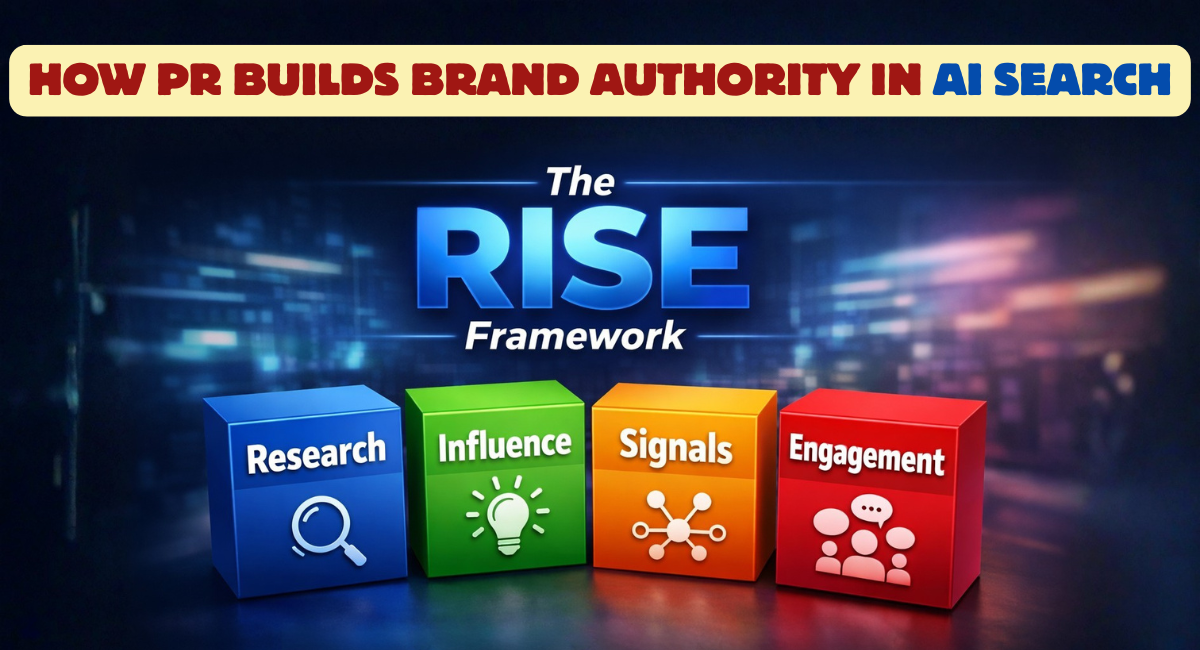
The RISE Framework: Research, Influence, Signals, Engagement
The RISE Framework structures your existing PR capabilities into a systematic approach for AI search authority. Each pillar builds on communications fundamentals while addressing the unique requirements of AI-powered discovery.
R – Research Your AI Visibility Footprint
Traditional media monitoring tracked mentions, sentiment, and share of voice. AI search monitoring adds a new dimension: citation analysis and narrative accuracy.
Start by conducting direct AI visibility audits. Open ChatGPT, Perplexity, and Google (to trigger AI Overviews) and search exactly how your stakeholders would:
- “Best crisis communications firms for pharmaceutical companies”
- “Compare media monitoring platforms for government agencies.”
- “Which PR agencies specialize in executive reputation management?”
- “Top media intelligence tools for enterprise communications teams”
Document which brands appear in responses, what sources AI cites, and how accurately AI represents your company’s positioning. Many brands discover a shocking disconnect—they dominate traditional search rankings while remaining invisible in AI-generated answers.
Test your entity recognition. Does ChatGPT correctly identify your company type, service offerings, target markets, and competitive positioning? AI misclassification can send qualified prospects to competitors, even when you have superior capabilities.
Map your media coverage patterns against what AI platforms cite. You’ll likely find AI pulling heavily from AP, Reuters, industry trade publications, and specialized research reports. Forbes and Harvard Business Review appear frequently. Reddit ranks among the top three most-cited sources across all major AI platforms.
This research phase reveals critical gaps. A financial services client we analyzed ranked first for every target keyword in Google, yet it appeared in zero AI responses related to its category. Their problem wasn’t SEO—they had that mastered. Their problem was a lack of editorial coverage and thought leadership that AI systems prioritize.
For PR teams, this research should integrate into existing media monitoring workflows. Track not just whether your brand gets mentioned, but whether those mentions appear in the types of sources AI platforms cite most frequently. Monitor competitor share of voice in AI-generated responses the same way you track traditional media coverage.
I – Influence Through Thought Leadership and Earned Media
If 90% of AI citations come from earned media, then influence—specifically, quotable expertise and authoritative third-party validation—becomes the primary driver of AI search success.
This pillar directly maps to PR’s core competencies. Every tactic that builds traditional media relationships now serves a dual purpose: immediate coverage and long-term AI visibility.
Position executives as quotable experts with unique perspectives. AI platforms prioritize content that includes citations, statistics, and direct quotes. Research from Princeton indicates that content incorporating these elements can achieve up to 40% higher visibility in AI-generated responses. Train your spokespeople to provide data-backed insights, not marketing messages.
Develop systematic approaches to earn coverage in AI-prioritized sources:
- Create original research that journalists reference
- Respond to journalist queries through platforms AI can access
- Contribute expert commentary on breaking industry news
- Publish thought leadership in authoritative trade publications
- Secure speaking opportunities at industry conferences that get covered
One key insight: comprehensiveness matters more than length. AI platforms favor detailed, well-structured content over brief posts. A 2,000-word thought leadership piece in an industry publication outperforms 10 optimized blog posts for AI citation purposes.
Build your visibility pyramid strategically. Technical optimization (schema markup, structured data) forms the foundation—call it 20% of the effort. The remaining 80% is split between executive thought leadership (40%) and earned media coverage (40%). This inverted model reflects AI’s prioritization of authoritative sources over technical signals.
Focus on publications where your prospects actually research decisions. For B2B communications professionals, this means publications such as PR Week, PRNews, Communication Director, and industry-specific trade publications. For enterprise technology PR, target outlets like TechCrunch, VentureBeat, and trade-specific publications.
The strategic shift: treat every media placement as a long-term asset that AI systems will reference for years, not just for immediate visibility. A single authoritative Forbes or Harvard Business Review article can generate AI citations for 18-24 months, far exceeding the lifespan of traditional content.
Track your team’s success in building quotable expertise. Are your executives cited in industry coverage? Do reporters contact your spokespeople for commentary? Does your original research get referenced by other publications? These traditional PR metrics now directly predict AI search visibility.
Media monitoring platforms designed for communications teams can track these influence patterns across both traditional media and AI citations. Look for tools that can identify which coverage drives the most AI visibility, allowing you to double down on the tactics that work. Fullintel’s strategic media analysis capabilities help PR teams connect media coverage patterns to downstream business impact, including AI search presence.
S – Signals That AI Systems Recognize
While influence drives the majority of AI visibility, technical signals still matter. This pillar addresses the structural elements that enable AI systems to parse, understand, and accurately cite your content.
Think of signals as the difference between a journalist finding your press release versus being able to quote it accurately. AI needs clear, structured information to synthesize answers confidently.
Structure content for AI comprehension. Use clear headers, bullet points, FAQ sections, and short paragraphs. AI platforms struggle with dense walls of text but excel at extracting information from well-organized content. Your newsroom and press release templates should prioritize scannability.
Implement schema markup on your website, particularly for your executive team, press releases, and thought leadership content. Schema.org offers structured data formats that enable AI systems to comprehend entities, relationships, and organizational hierarchies. This technical foundation won’t make you appear in AI responses by itself, but it ensures accuracy when you do appear.
Maintain content freshness as an operational priority. AI platforms demonstrably favor recent information—content updated within the past 30-90 days is prioritized over older material, even when the older content ranks higher in traditional search results. This validates what PR teams already know: breaking news, timely commentary, and current analysis drive more value than evergreen content.
Un-gate your best content. AI systems can’t cite research papers, whitepapers, or case studies locked behind form fills. Everything except product demos should be freely accessible. Yes, these changes lead to generation models. However, the alternative is to remain invisible in AI search while competitors who share knowledge freely capture attention.
Create Q&A-style content that mirrors natural language queries. AI excels at matching conversational questions to structured answers. FAQs, interview-format thought leadership, and “how-to” guides perform exceptionally well. Write content that answers the specific questions prospects ask, not just the keywords they search.
Optimize your press release distribution strategy for AI accessibility. Ensure releases live on your website with clean URLs, proper header hierarchy, and structured data markup. Syndicate through newswires that AI platforms can access. Test whether AI can find and cite your recent announcements—many companies discover their press releases are technically visible but structured in ways AI can’t easily parse.
For PR agencies and in-house teams, signals represent the operational infrastructure supporting your influence efforts. If thought leadership is the content, signals are the packaging that ensures AI can find, understand, and accurately cite it.
This pillar also addresses brand consistency across platforms. When different sources describe your company inconsistently, AI synthesizes those conflicts as uncertainty and prioritizes clearer alternatives. Create a single source of truth for how you describe your company, services, and positioning. Ensure that every team member, press release, and media pitch uses consistent language and tone.
E – Engagement in Communities AI Monitors
The engagement pillar extends your media monitoring and social listening to include the communities and platforms that AI systems actively crawl for current information.
AI platforms cite Reddit more frequently than almost any other source. Wikipedia accounts for 7.8% of ChatGPT’s citations. Quora, Stack Exchange, and industry-specific forums appear regularly in AI-generated responses. For PR professionals, this means stakeholder engagement now directly impacts AI visibility.
Build an authentic presence in relevant communities. Not promotional spam—genuine participation where your expertise adds value. Answer questions in your area of knowledge. Share insights on industry trends. Correct misinformation when your brand gets discussed. These contributions become a source material for AI systems reference.
Monitor conversations where your brand, industry, and competitors get discussed. Traditional social listening tools capture some of this, but you need visibility into Reddit threads, Quora discussions, and industry forums. When prospects ask “which media monitoring platform should we choose?” in a relevant community, AI might surface that thread in response to similar queries for months afterward.
Engage authentically, not promotionally. AI systems prioritize helpful, informative responses over marketing messages. A well-reasoned explanation of how different approaches to media monitoring solve different problems will outperform “contact us for a demo” every time.
Create mechanisms for rapid response when misinformation appears. If AI starts citing an inaccurate narrative about your brand, you need the monitoring systems to catch it early and the engagement strategy to correct it at the source. This requires monitoring both traditional media and the community platforms AI references.
Track stakeholder conversations as leading indicators of narrative shift. What questions are prospects asking in communities? What concerns keep appearing? These signals help you develop thought leadership that addresses fundamental information gaps—the exact content AI platforms will cite when those questions scale.
For crisis communications specifically, engagement becomes critical. AI systems amplify whatever narrative dominates source material. If negative coverage or community discussion outweighs your official response, AI will synthesize a predominantly negative answer. Your crisis response protocol needs to include community engagement, not just media relations.
The engagement pillar connects directly to PR’s relationship-building strengths. You already understand stakeholder communications. You already monitor sentiment and emerging narratives. AI visibility simply extends those practices to include the community platforms that AI systems use as real-time information sources.
New Metrics for AI Search Success
Traditional PR measurement—media impressions, advertising value equivalency, share of voice—captures only part of the picture. AI search demands new metrics that track citation patterns and narrative accuracy.
Start tracking citation frequency. How often does your brand appear in AI-generated responses for category-relevant queries? What’s your citation rate compared to top competitors? Which sources drive the most AI citations?
Monitor narrative accuracy. When AI describes your company, does it correctly identify your positioning, capabilities, and differentiators? Track misrepresentation the same way you track sentiment in traditional media. Incorrect AI narratives can persist for months, sending qualified prospects to competitors.
Measure share of voice in AI responses. Run standardized queries weekly and document which brands appear. Calculate your percentage of category mentions. Track whether you’re gaining or losing visibility relative to competitors.
Attribution becomes more complex. AI-influenced prospects rarely arrive via trackable links. They complete 99% of research before initial contact. Create specific attribution mechanisms—”How did you hear about us?” responses often reveal “ChatGPT” or “Perplexity” as discovery sources. Track these manually if your analytics can’t capture them automatically.
Calculate true business impact. AI-influenced prospects show higher qualification levels and faster sales cycles. Track deal velocity, average contract value, and win rates for prospects who mention AI discovery. These buyers arrive fully educated, significantly shortening your sales process.
For communications teams specifically, connect media coverage patterns to AI visibility outcomes. Which types of placements drive the most citations? Do executive interviews outperform press releases? Does original research generate more AI visibility than news announcements? This analysis helps you optimize your media strategy for both traditional and AI search impact.
Media monitoring platforms designed for PR professionals should evolve to include AI citation tracking. Look for capabilities that connect your earned media coverage to downstream AI visibility, creating a clear line of sight from PR activities to business outcomes.
Implementation Roadmap for PR Teams
Week 1: Conduct comprehensive AI visibility audits. Test 25-30 category-relevant queries across ChatGPT, Perplexity, and Google AI Overviews. Document current state, competitor presence, and citation sources. Identify gaps between your traditional search rankings and AI visibility.
Week 2-3: Align stakeholders around AI search as a strategic priority. Present audit findings to leadership. Establish baseline metrics. Create unified messaging guidelines ensuring brand consistency across all channels.
Month 2-3: Launch systematic thought leadership and media relations campaigns designed explicitly for AI visibility. Prioritize publications and platforms AI systems cite most frequently. Create original research that journalists will reference and cite as a reliable source. Position executives as quotable experts on industry trends.
Month 4-6: Scale what works. Double down on the tactics driving measurable AI citation growth. Expand community engagement in relevant forums and platforms. Implement technical optimizations (schema markup, content structure) that improve AI comprehension.
Ongoing: Conduct monthly AI visibility reviews in conjunction with traditional media monitoring reports. Track citation frequency, narrative accuracy, and competitive positioning in AI responses. Adjust strategy based on what drives qualified business opportunities, not just visibility metrics.
The most successful implementations treat AI visibility as an extension of existing PR workflows, not a separate initiative. Your media monitoring, social listening, and measurement systems should incorporate AI citation tracking as a standard capability.
The PR Advantage in AI Search
While marketing teams rush to hire GEO specialists and SEO consultants pivot their offerings, PR professionals already possess the strategic capabilities AI search demands. You understand how to earn third-party validation. You build relationships with journalists and editorial teams. You craft narratives that resonate across multiple channels. You monitor how your brand gets represented in external sources.
These core competencies now determine brand visibility in the platforms your stakeholders use for research and discovery. The shift from keyword optimization to authority building favors communications professionals who understand media dynamics, rather than technical specialists who specialize in search algorithms.
Approximately 54.6% of U.S. adults now use generative AI on a regular basis. ChatGPT processes more searches daily than Bing processes globally. AI-sourced website sessions grew 527% year-over-year through mid-2025. These aren’t future trends—they’re current reality reshaping how stakeholders discover, evaluate, and engage with brands.
The RISE Framework structures your response: Research your current AI visibility, build Influence through earned media and thought leadership, optimize Signals for AI comprehension, and drive Engagement in communities AI monitors. Each pillar leverages your existing skills while addressing the unique requirements of AI search.
Start by understanding where your brand appears—or doesn’t appear—in AI-generated responses. Use that research to identify the specific media coverage and thought leadership gaps preventing AI citation. Then, systematically build the authority that makes your brand the go-to source for AI in your category.
PR professionals who master AI search optimization will not only protect their brands from visibility loss but also enhance their brands’ online presence and reputation. They’ll capture a disproportionate share of the highest-quality prospects: the fully-educated buyers who arrive ready to engage because AI recommended them specifically to your door.

Ted Skinner
Ted Skinner is the VP of Marketing at Fullintel with extensive experience in AI implementation for public relations and media monitoring. A recognized expert in crisis communication strategy and competitive intelligence, Ted specializes in developing practical applications for AI in PR workflows. His thought leadership focuses on helping PR professionals leverage technology to enhance strategic communications while maintaining the human insight that drives successful media relations.
Read more of Ted’s insights on AI-powered PR strategies and follow his latest thinking on modern measurement approaches.

Ted Skinner is the VP of Marketing at Fullintel with extensive experience in AI implementation for public relations and media monitoring. A recognized expert in crisis communication strategy and competitive intelligence, Ted specializes in developing practical applications for AI in PR workflows. His thought leadership focuses on helping PR professionals leverage technology to enhance strategic communications while maintaining the human insight that drives successful media relations.
Read more of Ted’s insights on AI-powered PR strategies and follow his latest thinking on modern measurement approaches.