

Why Tracking AI Mentions Is Now Essential for PR
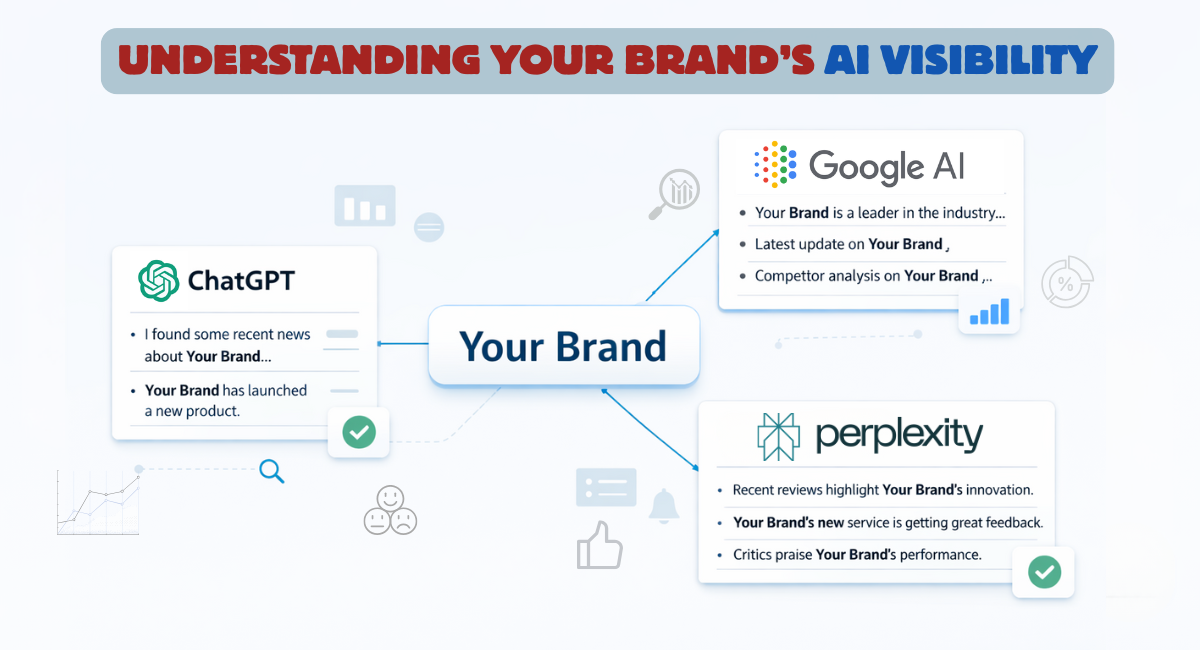
Media measurement is evolving alongside readers. We’re no longer just examining individual articles to understand a story, but rather considering articles as part of a broader picture of influence. As more and more traffic is siphoned away by AI-driven overviews and chat experiences from publishers, AI becomes a powerful mediating agent that flattens brand awareness to descriptive sentences.
Those sentences and bullets, opinions nested within, can drag up more than just your newest press release, but your oldest issue. The question is whether you should monitor LLMs and the chat agents they drive, and if so, how to do so.
For enterprise brands that have invested in SEO and strong web best practices for years, evaluating AI outputs from Google, OpenAI, Perplexity, and Claude is more about maintenance than growth. Those best practices will only benefit them so long as there is stewardship and measurement. Much like hybrid AI and human analysis in media monitoring, tracking brand mentions across AI platforms requires both automated tools and strategic human oversight.
Understanding the Four AI Platforms You Need to Monitor
Pew says about 9% of Americans are getting news from chatbots, as they say, “Most Americans never get news from AI Chatbots.” Radio, as an example, is the news platform of choice for only 5% of American consumers. I don’t see Pew writing a similar headline about that!
When considering these platforms, there are really only four worth tracking. Evaluating them from an audience perspective isn’t to knock their capabilities, but rather to acknowledge their reach.
ChatGPT receives approximately 5 billion monthly visits. Considering the impact it has had on Google’s web traffic has been marginal at best. Google’s Gemini itself boasts more than 2 billion monthly users (apples to oranges, Gemini is huge), and again, when you consider AI mode in search uses Gemini now, Google may already hold 90% of the audience share. Who’s the top dog now?
Perplexity and Claude, while both fall within the 200 million range in monthly active visits, still catch headlines, and millions of visits and active users are certainly noteworthy. The use cases differ, and the audience is distinct. Claude’s growing enterprise adoption and programmatic coding workflows help it present a different view. Still, if time is critical, skip the latter two.
Method 1: Manual Monitoring (Free, Time-Intensive)
The Free-ish Strategy: The AI Stakeholder “Panel”
When all you have is a hammer, all you see are nails. However, what if that hammer could transmogrify into a sawzall?
The challenge of using new tools for old jobs is that it can be the wrong tool for the task, but if you are already compiling a media monitoring report manually, adding AI to that view isn’t the most challenging part of your day-to-day; it is just another source to run and program element to build in.
By “Free,” I mean not thousands of dollars a year. You can pay somewhere between $140 and $1,200 a year and get a great deal out of using modern LLM software in terms of understanding your brand.
Cost: ~$20/month (ChatGPT Plus or Gemini Advanced)
Time: 30 minutes/week
Assuming you are already reading a few hundred articles a month, adding a virtual media and audience panel doesn’t significantly expand your collection. First, you will build a virtual “Panel” of AI personas representing your key stakeholders (e.g., The Skeptical Investor, The Gen-Z Consumer, The Competitor). You will use the “Projects” feature in ChatGPT or “Gems” in Gemini to lock these personas in place so they remember your brand context week after week.
Setup: Build Your Panel (Do This Once)
Don’t just start a new chat every time. Use the advanced features to save your context. This way, just like you return and run a search on a news website or aggregator, you can rerun your prompt and get the right results.
- In ChatGPT: Create a “Project” named “Brand Reputation Monitor.” Upload your press releases, recent coverage, and brand guidelines to its knowledge base.
- In Gemini: Create a “Gem” named “Brand Guardian.” Give it instructions to always act as a panel of diverse critics.
The Prompt to Set Your Baseline
“You are a panel of three distinct personas evaluating [Brand Name]:
- The Cynic: A tech-savvy critic who distrusts corporate jargon.
- The Executive: A C-suite leader focused on stock price and market leadership.
- The Loyalist: A long-time customer who loves the product but fears change.
I will feed you news or search queries about our brand. You will output a table showing how EACH persona interprets that news.”
The 30-Minute Weekly Protocol
Output Format: Request a Markdown table for easy copying and pasting.
Step 1: The “Pulse Check”. Ask your AI to search the web for the last 7 days of news regarding your brand and key competitors.
Prompt: “Search for all news mentions of [Brand] and [Competitor X] from the last 7 days. Summarize the top 3 narratives.”
Step 2: The Panel Simulation. Ask your “Panel” to react to these specific narratives.
Prompt: “Based on these news stories, how does the Panel react? Create a table with columns: Persona, Sentiment (Positive/Negative/Neutral), Key Concern, and ‘What they would tweet’.”
Step 3: The Gap Analysis. Ask the AI to identify what is missing or what has changed from the previous week.
Prompt: “Compare this week’s sentiment to last week’s. Are we seeing ‘narrative drift’ where the story is moving away from our core messaging?”
What to Look For
- Narrative Drift: Is the AI associating your brand with new, unintended keywords (e.g., “expensive,” “delayed,” “complicated”)?
- The “Filter Bubble” Check: If the “Executive” persona sees good news but the “Cynic” sees bad news, a communication gap exists that needs to be addressed.
- Competitor Envy: Ask the panel, “If you were the Competitor, how would you exploit [Brand’s] news from this week?”
Method 2: Scalable Tools for Enterprise Brands
For organizations managing multiple sub-brands or complex product portfolios, manual monitoring quickly becomes unsustainable. This is where AI-powered monitoring tools, which integrate automated tracking with human analysis, become essential.
Several platforms now offer automated AI mention tracking:
- Semrush: Tracks how brands appear in AI-generated search results and provides competitive analysis
- ScrunchAI: Monitors brand mentions across multiple AI platforms with automated alerting
- Fullintel’s Strategic Media Analysis: Combines AI monitoring with human analyst oversight to identify patterns and strategic implications across traditional and emerging channels
The key advantage of enterprise tools is their ability to scale. What takes 30 minutes per brand weekly can be automated across dozens of brands simultaneously, with alerts triggered only when significant changes occur.
Setting Up Alerts and Reporting
By analyzing the influence of top outlets on AI, you can set up alerts through your media monitoring vendor, targeting those outlets specifically. When you earn a hit, the alert pops off, and you can expect that at some point, the LLM panel will pick it up, hopefully.
There is something you can do right away after creating any piece of earned content: write a small post on your site that validates the story and provides your commentary. That is another trust signal, that what the media is saying is true, or at least you aren’t refuting it.
Moving on, you’ll have a post to write and reporting to build.
Getting this into a template is essential. Think about the following before starting your reporting grid, or even before writing a prompt to help you get started: just think about columns and rows.
Components
- What perceptions are you trying to change? If there is something about your LLM responses that you want to improve, what is it? Can you put it into words, or measure its inclusion in the reaction? Place these into Columns: Platitudes and Attitudes, measure over time.
- Raw Responses by Persona: You’ll be generating tables for your responses to begin with, ensuring that you have a data frame to drop those into for concurrent measurement is great. Store the raw reactions so you can hand-evaluate them for context and hallucinations.
- Competitor Inclusion: How often are XYZ competitors included in the responses? This can be both raw mentions or a share of model (SOM).
- Recommendations: Any AI tool will provide recommendations and follow-up actions; these are just that, recommendations. They carry as much weight as you want them to, but really, it is about validation. Do you want to trust a data insight from an AI that you can’t independently verify? Disclaim it, validate if you want to pursue the idea, but leave it if it isn’t helpful. Are the recommendations changing over time? How they change is interesting in itself. Keep track.
With those ideas plotted, monthly reporting will be easier, or at least surfacing enough prompts over a month, with aggregated data to imply some visibility. How wide a window, how clear a picture is more a depiction of positive brand outcomes.
Don’t look at share of model as a success metric; look at share of wallet.
Interpreting Results and Taking Action
Collecting the data is only half the battle; the real value comes from deciphering what the AI’s “black box” is telling you about your brand’s reputation. Here is how to read the signals from your AI stakeholder panel.
What Good AI Visibility Looks Like
Success in AI visibility isn’t just about volume; it is about the integrity and alignment of the narrative. When you review your weekly “Panel” simulation, “good” looks like this:
Narrative Consistency is key; the AI summaries align with your core messaging, rather than exhibiting “narrative drift”. The descriptive sentences used by the LLM match the tone of your most recent press release rather than dragging up old issues.
Here are a couple of other things to consider when you are reading your panel outputs or AI visibility reports:
- Unified Panel Sentiment: There is no “Filter Bubble” gap. If the “Executive” persona sees growth, the “Cynic” persona isn’t surfacing, contradicting negative news; they are seeing the same story, even if they interpret it differently.
- High-Quality Attribution: The recommendations and summaries provided by the AI are backed by high-credibility sources, reinforcing the “triangle of trust” between the outlet, the author, and the platform.
- Share of Model Dominance: When analyzing competitor inclusion, your brand holds the primary focus in the response, rather than the AI immediately recommending a competitor as a better alternative.
Red Flags to Watch For
Your monitoring routine is an early warning system. If you see these patterns in your “Pulse Check” or “Panel Simulation,” immediate PR intervention is needed.
Just as being consistent is beneficial, being inconsistent can be detrimental. Think of it like a filter bubble split, where your “Executive” persona sees positive news while the “Cynic” sees negative news or misinformation. This indicates a communication gap where your positive messaging isn’t penetrating critical or skeptical circles. It can highlight socioeconomic or demographic perspective differences, highlighting where you are weak.
- Zombie Narratives: The AI continues to cite your oldest issues or resolved crises alongside your newest news. This suggests the LLM has not “learned” that the problem is resolved, requiring you to flood the zone with fresh, authoritative content.
- Competitor Exploitation: Your panel reveals explicit opportunities where a competitor could capitalize on your current news cycle. If the AI can see the weakness, your competitors (and savvy customers) can too.
- Hallucinations: The raw responses contain data or claims that cannot be independently verified. You must catch these before they become accepted facts in the public domain.
Actions to Improve AI Visibility
Once you have identified the gaps, you can’t just “SEO” your way out of it. You need to take specific PR actions to influence the training data.
- Validate Earned Media: When you get a great media hit, don’t just let it sit. Write a post on your own site validating the story and providing your own commentary. This serves as a “trust signal” to the LLM, indicating that the media coverage is accurate and authoritative.
- Target Influential Outlets: Utilize your monitoring to identify which specific media outlets are most effectively feeding the AI. Set up alerts for these particular publications and prioritize pitching them, as they have a significant impact on chat platform answers.
- Hand-Evaluate and Disclaim: Don’t blindly trust AI recommendations. Store the raw responses and manually evaluate them for context. If the AI suggests a strategy or insight you can’t verify, disclaim it and move on. Use the tool for validation and ideation, not strategic direction setting.
Common Challenges and How to Solve Them
While monitoring AI provides a new layer of intelligence, it introduces friction points that differ from traditional media monitoring. The most common hurdle is the time-to-scale ratio.
- The Scaling Problem: The “30-minute weekly protocol” is effective for a single business unit, but it is not linear. When you manage multiple sub-brands or product categories, that time commitment explodes into hours of manual prompting.
- Solution: For complex organizations, manual monitoring isn’t sustainable. You will eventually need to migrate to scalable tools (like Semrush or ScrunchAI) that can automate the panel creation and prompting process. Alternatively, an integrated approach that blends these AI simulations with human-curated data can help filter the noise before it reaches your desk.
- The “Simulation” Trap: It is critical to remember that AI panels are simulations, not focus groups. They do not reflect the real-time browsing history, location data, or personal biases of an actual individual user.
- Solution: Treat these insights as directional validation rather than absolute truth. Use the AI to identify potential vulnerabilities or narrative gaps, but rely on your website analytics and direct customer feedback to verify if those gaps are affecting real human behavior.
- Data Verification and Hallucinations: The “black box” nature of these models means they often surface recommendations or claims that cannot be independently verified.
- Solution: To ensure the AI isn’t hallucinating facts or dredging up “zombie narratives” that were resolved years ago, you must store the raw responses and manually evaluate them for context.
Creating a Sustainable Monitoring Routine
To prevent this from becoming just another abandoned tool, you need to institutionalize the listening process. This is what real listening means; it doesn’t always mean you take immediate action, but that there is some sharing and understanding of what’s happening in the channel.
- Treat it Like a Beat: Just as you or your team might read specific trade journals every morning, the “AI Pulse Check” needs to be a scheduled habit. Running queries periodically from different locked personas ensures you are consistently viewing your brand through the eyes of your specific stakeholders.
- Template Your Findings: Don’t just read the chat window and close it. Maintain a simple reporting grid (or spreadsheet) to document raw responses and key links. This allows you to track “narrative drift” over weeks rather than relying on memory.
Focus on Share of Wallet. It is easy to get obsessed with “Share of Model” (how often you appear), but the real metric is “Share of Wallet” (conversion and intent). Use the monitoring to ensure the AI is positioning your brand for the right reasons, not just any reason.
The Future of AI Brand Monitoring
As AI platforms continue to evolve and capture an increasing share of search traffic, monitoring your brand’s representation in these systems will transition from optional to essential. The brands that establish monitoring protocols now will have years of baseline data to understand how their narrative shifts over time.
Think of this as the early days of SEO, when forward-thinking brands invested in optimization before their competitors understood its value. The same opportunity exists today with AI visibility. Start small with the manual “Panel” approach, document what you learn, and scale up as your organization recognizes the strategic value.
The question isn’t whether AI will mediate your brand’s reputation. It already does. The question is whether you’ll be watching when it happens.
Ready to upgrade your media monitoring strategy? Fullintel’s Strategic Media Analysis combines AI-powered tracking with expert human analysts to deliver actionable intelligence across traditional and emerging channels. Schedule a consultation to see how we can help you stay ahead of the narrative.