Predictive AI + Human Insight: The Future of Proactive PR Media Monitoring
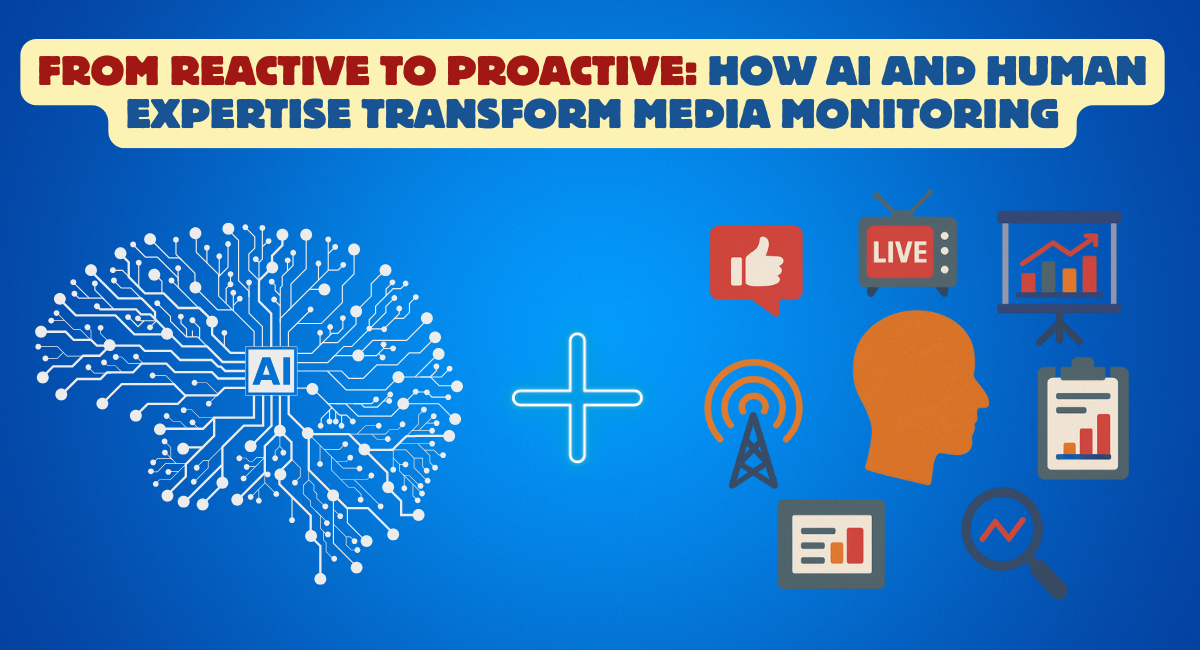
In today’s hyper-connected media landscape, PR professionals face an unprecedented challenge: How do you spot the stories that matter before they explode into trending topics? The answer lies in combining cutting-edge predictive AI with expert human analysis and using advanced media monitoring tools that transform reactive monitoring into proactive intelligence.
The Data Deluge: Why Traditional Monitoring Falls Short
Every day, PR professionals wade through an overwhelming ocean of content. News articles, social media posts, influencer commentary, and broadcast segments flood monitoring dashboards faster than any human can process. This information overload creates a dangerous blind spot: critical stories get buried beneath irrelevant clips, and by the time teams notice emerging issues, it’s often too late for strategic response.
The numbers tell a stark story. According to recent PRSA and AMEC research, 89% of communications professionals say proving impact remains their top measurement goal, yet 48% still struggle to demonstrate clear ROI from their media monitoring efforts. This disconnect stems from a fundamental problem—many traditional media monitoring tools amplify noise rather than filtering signal.
Consider the typical morning routine: PR professionals scan hundreds of mentions, manually categorize sentiment, and attempt to identify which stories deserve immediate attention. This reactive approach keeps teams constantly playing catch-up, missing opportunities to get ahead of potential crises or amplify positive coverage before competitors notice.
The result? Teams remain perpetually reactive, missing both emerging crises and breakthrough opportunities that could significantly impact their organization’s reputation and bottom line.
This shift has been driven largely by the evolution of AI-powered media monitoring tools that make it possible to detect trends before they surface.
Real-World Applications: From Reactive to Proactive
The AI Revolution in PR Media Monitoring
Artificial intelligence has rapidly transformed how PR professionals approach media monitoring. Recent industry data shows that 85% of PR practitioners now use AI tools in their daily workflow, with 60% relying on AI regularly for media scanning, sentiment analysis, and alert generation. This widespread adoption signals a fundamental shift in how the industry processes information.
How AI Transforms Media Analysis
Modern AI systems excel at pattern recognition and data processing at scales impossible for human analysis. Machine learning algorithms can identify viral potential by analyzing velocity patterns, audience resonance, and content amplification across multiple channels simultaneously. These systems detect subtle shifts in coverage volume, sentiment trajectories, and topic momentum that human monitors might miss.
For example, trend detection algorithms can analyze thousands of articles per minute, identifying emerging narratives based on keyword clustering, source authority, and social media engagement patterns. This capability allows PR teams to spot developing stories hours or even days before they reach mainstream attention.
The efficiency gains are remarkable. Where human analysts might process dozens of articles per hour, AI systems can analyze thousands, categorizing content by relevance, sentiment, and potential impact. This processing power enables comprehensive media monitoring that covers global news sources, social platforms, and niche industry publications simultaneously.
For enterprise organizations managing communications across multiple regions, languages, and market segments, AI-powered monitoring becomes essential infrastructure. Our comprehensive guide to effective media monitoring explores how global enterprises can navigate the complexities of modern media intelligence while maintaining consistency across diverse markets and stakeholder groups.
Moreover, 76% of communications teams report actively adopting new AI-powered tools, indicating that this technological shift is accelerating rather than plateauing. The organizations that embrace AI-enhanced monitoring gain significant competitive advantages in response time and strategic positioning.
The Irreplaceable Human Element
While AI excels at data processing and pattern recognition, human expertise remains essential for contextual understanding and strategic interpretation. AI systems, despite their sophistication, cannot fully grasp nuanced communication like sarcasm, cultural references, or industry-specific subtleties that dramatically impact message interpretation.
Where Human Analysts Excel
Human analysts bring irreplaceable capabilities to media monitoring. They distinguish between satirical commentary and genuine criticism, understand the difference between a minor influencer’s viral moment and sustained negative coverage, and recognize industry-specific terminology that might confuse AI systems. This contextual understanding proves crucial for accurate threat assessment.
Consider the challenge of monitoring pharmaceutical communications. A human analyst understands that coverage in specialty medical journals carries different weight than general health blog posts, even if AI sentiment analysis rates them similarly. Similarly, analysts can identify when apparent negative coverage actually represents balanced reporting that poses no reputational risk.
Human experts also excel at validating AI predictions, filtering misinformation, and customizing monitoring parameters based on organization-specific sensitivities. They understand that a mention of “clinical trial results” might be routine news for one client but a crisis trigger for another, depending on their current regulatory environment.
As AMEC research emphasizes, measurement without proper context becomes mere guesswork. Human analysts provide the contextual framework that transforms raw data into actionable intelligence.
PredictiveAI: The Future of Proactive Monitoring
The evolution toward truly predictive monitoring represents a paradigm shift from reactive to proactive PR strategy. Fullintel’s proprietary PredictiveAI™ technology exemplifies this advancement, combining machine learning with decades of media analysis expertise to forecast story trajectory before widespread coverage begins.
The Technical Foundation of PredictiveAI™
What if you could know which stories will trend 24-48 hours before they go viral? That’s not science fiction—it’s the everyday reality with Fullintel’s PredictiveAI™ technology. Built on over 40 years of carefully annotated media data and more than 100 proprietary machine-learning models, this system doesn’t just show you what already happened—it gives you a crystal ball into what’s coming next.
PredictiveAI™ works by combining several advanced technologies into a comprehensive predictive engine:
Velocity Tracking and Pattern Recognition
The system monitors how quickly stories spread across different media types, analyzing acceleration patterns that indicate viral potential. Machine learning algorithms study historical data patterns of how stories evolve from initial mentions to viral events, identifying early signals that correlate with future impact.
Source Influence Measurement
Not all mentions are equal. PredictiveAI™ weighs mentions based on the historical influence of the source, reaching beyond simple follower counts to measure actual impact. The system understands which sources actually influence stakeholders rather than just who makes the most noise.
Advanced Natural Language Processing
Our algorithms analyze the content, tone, and context of media mentions to understand their meaning beyond simple keywords. This includes semantic network analysis that maps relationships between stories, topics, and influencers, identifying emerging narrative clusters before they converge into major stories.
Anomaly Detection
The system identifies unusual patterns in coverage or social engagement that often precede major news events, flagging these for human analysis. This multi-factor approach creates a predictive engine with remarkable accuracy in identifying tomorrow’s major stories today.
Real-World PredictiveAI™ Success Stories
Consider this real example: When Target noticed early warning signs about shipping delays, PredictiveAI™ flagged it three days before it exploded on social media. Their team had already developed talking points and implemented a comprehensive response plan while their competitors were still scrambling to understand what hit them.
The human-in-the-loop model enhances this technological capability. Expert analysts review AI predictions, validate emerging trends, and refine algorithms based on real-world outcomes. This collaborative approach continuously improves accuracy while maintaining the contextual understanding that pure automation cannot provide.
This predictive capability enables entirely new strategic approaches. Instead of responding to coverage after it appears, PR teams can prepare responses for stories that haven’t yet gained mainstream attention. They can amplify positive coverage before competitors notice opportunities or implement crisis protocols before issues escalate beyond manageable levels.
For a comprehensive understanding of how PredictiveAI™ transforms modern PR strategy, explore our detailed media monitoring guide that breaks down the technical capabilities and real-world applications of predictive intelligence.
The Complete AI-Powered Media Intelligence Suite
While PredictiveAI™ represents the cutting edge of forecasting technology, it’s part of a comprehensive suite of AI-powered media monitoring tools designed specifically for PR professionals. The Fullintel Hub AI Edition introduces several game-changing capabilities that work together to transform how PR teams operate.
MattAI: Your 24/7 Media Intelligence Assistant
Think of MattAI as your personal PR intelligence expert who never sleeps. Available 24/7 to answer critical questions about coverage, competitors, or industry trends, MattAI taps directly into your curated media intelligence to deliver answers relevant to your unique situation. Unlike generic AI assistants that regurgitate public data, MattAI provides instant, contextual responses like “How has our sustainability messaging performed this quarter?” or “What’s the sentiment around our competitor’s new product launch?”
AI Overviews: Executive-Ready Intelligence
Remember those frantic mornings scanning dozens of articles before your 9 AM meeting? AI Overviews eliminate that struggle by providing executive-ready briefings that highlight priorities, spot emerging trends, and identify competitive movements worth noting. These smart summaries are perfectly formatted for immediate sharing with leadership, complete with opportunity alerts for potential positive stories to amplify.
AI-Powered Alert Systems
Traditional keyword alerts flood inboxes with noise. Fullintel’s AI Alerts provide contextual information explaining why each mention matters, assess potential impact, analyze source importance, and suggest actionable next steps. When Ford needed to stay on top of tariff discussions affecting their supply chain, these AI Alerts notified their team within minutes of breaking developments, complete with context and strategic recommendations.
Automated Newsletter Generation
Creating stakeholder updates used to consume entire days. AI Newsletters now handle this automatically, creating polished, branded updates with customizable templates, automatic generation schedules, and audience targeting for different stakeholder groups. Marriott’s team used to spend full days creating briefings for regional managers about local market coverage—now AI Newsletters handle it automatically with doubled engagement rates.
The practical applications of predictive AI plus human insight create tangible advantages for PR professionals across various scenarios. These use cases demonstrate how advanced monitoring transforms daily PR operations from reactive scrambling to strategic preparation.
Crisis Prevention and Early Response
Traditional monitoring typically alerts teams after negative coverage achieves significant reach. Predictive systems can identify brewing issues 48 hours before they trend, providing crucial time for strategic response. This early warning capability allows teams to address concerns proactively rather than defensively.
For organizations requiring 24/7 situation management, predictive monitoring becomes even more critical. PR crises don’t care if it’s 2 AM on Saturday or Christmas morning—that’s why Fullintel offers 24/7/365 crisis monitoring and response capabilities, earning multiple AMEC Awards for excellence in crisis communications.
When a crisis hits, one call to Fullintel’s crisis hotline activates the entire command center. Within minutes, teams receive real-time alerts and expert briefings tracking everything across all channels—including hidden corners most automated tools miss. The system provides actual analysis of how situations evolve and what’s likely coming next, not just raw data dumps.
Just ask the major tourism company that Fullintel helped navigate through a potential reputation nightmare. The award-winning crisis management approach kept negative commentary below 5% throughout the entire incident through strategic intelligence and perfectly timed alerts. Their executive team called it “the difference between a minor headache and a career-ending disaster.”
Opportunity Amplification
Predictive intelligence also identifies positive coverage opportunities before they reach peak visibility. PR teams can amplify favorable stories, coordinate with journalists for expanded coverage, or prepare supporting materials while competitors remain unaware of developing trends.
This proactive approach extends to influencer relations, partnership opportunities, and thought leadership positioning. Teams can engage with emerging conversations while they’re still manageable rather than trying to insert themselves into established narratives.
Strategic Media Planning
Predictive insights enable more sophisticated media planning around known issues or anticipated events. Teams can prepare for coverage spikes around earnings announcements, product launches, or industry developments, ensuring they’re ready to shape narratives rather than simply respond to them.
Measuring Success: ROI and Outcome-Based Metrics
The combination of predictive AI and human analysis directly addresses the measurement challenges that plague traditional monitoring approaches. Executives increasingly demand metrics tied to tangible business outcomes rather than vanity metrics that fail to demonstrate real impact.
Modern Measurement Standards
The industry has definitively moved beyond outdated metrics like Advertising Value Equivalents (AVEs). Today’s measurement standards focus on outcome-based metrics that demonstrate clear business value: message pull-through rates, share of voice trends, crisis mitigation impact, and real-time sentiment trajectory analysis.
The AI-plus-analyst model supports these advanced measurement approaches by providing the data accuracy and contextual interpretation necessary for meaningful analysis. Automated systems can track message consistency across thousands of mentions while human analysts validate the strategic significance of coverage patterns.
Research indicates that 75% of PR professionals now provide monthly measurement reports to executive leadership, reflecting the growing demand for regular, data-driven performance assessment. Predictive monitoring enhances these reports by demonstrating proactive value rather than merely documenting reactive responses.
Demonstrating Proactive Value
Predictive monitoring creates new opportunities for demonstrating PR value. Teams can document crisis prevention efforts, quantify the impact of early response strategies, and measure the effectiveness of proactive amplification campaigns. This capability transforms PR from a cost center into a strategic revenue driver.
What This Means for Enterprise PR Operations
The evolution toward predictive AI-enhanced monitoring fundamentally changes how enterprise PR organizations approach their global communications responsibilities. Rather than drowning in dashboard overload across multiple regions and languages, teams receive actionable alerts that enable strategic decision-making and proactive response across all markets simultaneously.
Solving Enterprise-Scale Challenges
Enterprise communications teams face unique complexities that predictive AI directly addresses. Managing media monitoring across multiple regions requires navigating diverse languages, cultural contexts, local media landscapes, and varying subscription services. Traditional monitoring approaches often create data silos, scoring inconsistencies, and blind spots that leave global brands vulnerable to regional reputation risks.
Fullintel’s AI-powered platform eliminates these challenges by providing unified intelligence across all markets, languages, and data systems. Instead of juggling multiple monitoring subscriptions with inconsistent methodologies, enterprise teams access comprehensive global coverage through a single, integrated platform that maintains scoring consistency and cultural context awareness.
Enhanced Enterprise Capabilities
Enterprise PR professionals working with advanced monitoring systems report dramatically improved coordination across global teams and markets. Instead of spending hours reconciling different monitoring outputs from various regional subscriptions, they focus on high-value activities like strategic planning, stakeholder relationship building, and coordinated campaign development.
The technology handles the heavy lifting of cross-regional content processing and cultural context analysis, allowing professionals to concentrate on interpretation, strategy development, and executive communication. This shift from operational coordination to strategic focus elevates the entire global communications function.
Organizations implementing AI-enhanced monitoring with human oversight report faster response times across time zones, better crisis preparation for global incidents, and more sophisticated strategic positioning that maintains consistency while respecting local market nuances. The combination of technological efficiency and human expertise creates capabilities that neither approach could achieve independently across enterprise-scale operations.
Preparing for Global Communications Excellence
As predictive AI technology continues advancing, enterprise PR professionals must adapt their skills to leverage these capabilities across diverse markets and stakeholder groups. The most successful practitioners will be those who understand how to leverage AI capabilities while providing the human insight and cultural understanding that technology cannot replace.
This evolution requires continuous learning and adaptation across global teams. Professionals must develop comfort with AI-generated insights while maintaining the critical thinking skills necessary for strategic interpretation and cultural context awareness that enterprise communications demands.
Actionable Next Steps for Enterprise PR Teams
Implementing predictive AI-enhanced monitoring across enterprise organizations requires strategic planning and systematic integration across multiple regions and stakeholder groups. Organizations should begin by evaluating their current monitoring capabilities and identifying specific areas where predictive intelligence could provide immediate value across their global operations.
Start by assessing your enterprise team’s biggest monitoring challenges across all markets. Are you missing early crisis signals in key regions? Struggling to maintain consistent messaging across diverse cultural contexts? Having difficulty demonstrating ROI from multiple monitoring subscriptions? These pain points indicate where predictive AI can provide the most immediate impact for global communications operations.
Consider pilot programs that test predictive capabilities in specific regions or product lines before full enterprise implementation. This approach allows teams to develop comfort with AI-generated insights while maintaining existing monitoring workflows during the transition period across all markets.
Invest in training that helps global team members understand how to interpret AI predictions and integrate them into strategic decision-making processes across different cultural contexts. The most successful enterprise implementations combine technological capability with enhanced human expertise that respects local market nuances while maintaining brand consistency.
Focus on platforms that can unify your monitoring across multiple languages, data systems, and regional subscriptions while eliminating scoring bias and cultural blind spots. Enterprise organizations need solutions that provide comprehensive global coverage without the complexity of managing multiple vendor relationships and inconsistent methodologies.
Frequently Asked Questions
How accurate is predictive AI in media monitoring?
Predictive AI systems achieve high accuracy rates when combined with human analyst oversight. The continuous learning model means accuracy improves over time as algorithms analyze more data and receive human validation feedback.
What types of stories can predictive AI identify early?
Predictive systems excel at identifying trending topics, viral content potential, crisis development, and amplification opportunities. They’re particularly effective for stories that follow recognizable patterns in velocity, engagement, and source authority.
How does human analysis enhance AI predictions?
Human analysts provide contextual understanding, validate AI predictions, filter false positives, and customize monitoring parameters based on organization-specific needs. This combination ensures both efficiency and accuracy in media monitoring.
Can enterprise organizations benefit from predictive AI monitoring?
Absolutely. Enterprise organizations face unique challenges that predictive AI-enhanced monitoring directly addresses: managing communications across multiple regions, languages, data systems, and subscription services while maintaining consistent brand messaging and avoiding scoring bias across diverse markets and cultural contexts.
The future of enterprise PR media monitoring lies in the strategic combination of predictive AI technology and expert human analysis that operates seamlessly across multiple regions, languages, and cultural contexts. This partnership enables truly proactive global communications strategy, transforming how enterprise PR teams identify opportunities, prevent crises, and demonstrate measurable business impact across diverse markets.
Enterprise organizations that embrace this hybrid approach will gain significant competitive advantages in response time, strategic positioning, and stakeholder communication across all their global operations. The question isn’t whether to adopt predictive AI-enhanced monitoring—it’s how quickly you can implement it effectively across your entire enterprise communications infrastructure.
Ready to transform your global media monitoring from reactive to proactive? Discover how predictive AI combined with expert human insight can revolutionize your enterprise PR strategy, eliminate the complexity of managing multiple monitoring subscriptions, and demonstrate clear ROI to executive leadership across all markets and regions.

Ted Skinner
Ted Skinner is VP of Marketing at Fullintel, where he focuses on AI implementation in PR and media monitoring. With extensive experience in crisis communication strategy and client communication optimization, Ted helps PR professionals leverage cutting-edge technology to achieve measurable results. His expertise spans AI-powered monitoring solutions, crisis response frameworks, and strategic media analysis.
Read more of Ted’s insights on AI-powered PR strategies and follow his latest thinking on modern measurement approaches.

Ted Skinner is the VP of Marketing at Fullintel with extensive experience in AI implementation for public relations and media monitoring. A recognized expert in crisis communication strategy and competitive intelligence, Ted specializes in developing practical applications for AI in PR workflows. His thought leadership focuses on helping PR professionals leverage technology to enhance strategic communications while maintaining the human insight that drives successful media relations.
Read more of Ted’s insights on AI-powered PR strategies and follow his latest thinking on modern measurement approaches.