Zero-Click Searches Hit 60%: The New Reality of PR Measurement in 2026
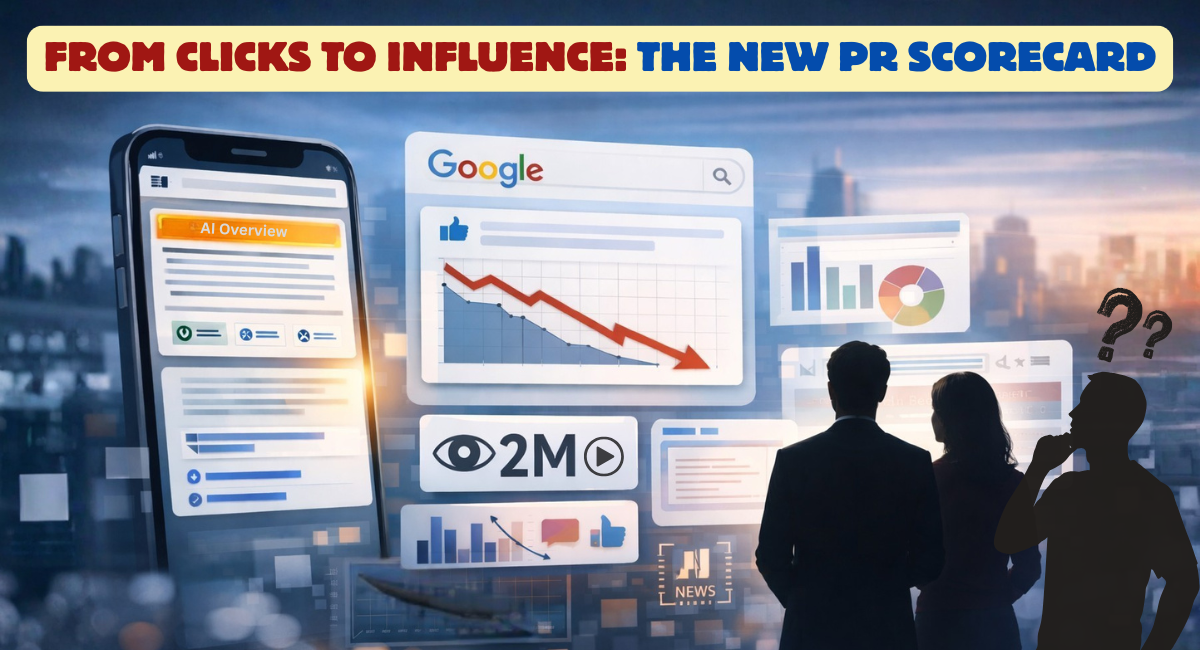
More than half of all Google searches now end without anyone clicking a single link. That’s the reality PR teams face in 2025, and it’s reshaping everything we thought we knew about measuring earned media success. The implications are significant: your best coverage might generate impressive impressions but send almost no one to your website. Your carefully crafted campaign could influence thousands of decisions without producing a single trackable click.
This isn’t a temporary blip. According to SparkToro’s 2024 study analyzing tens of millions of searches, 58.5% of Google searches in the US ended without a click to any website. By May 2025, Similarweb reported that number had climbed to 69%—a 13-percentage-point jump in just one year. The culprit? Google’s AI Overviews, which launched broadly in May 2024 and have fundamentally changed how people consume information through search.
For PR professionals, this means the metrics that justified our work for decades are becoming unreliable indicators of actual impact. We need new approaches. Fast.
The Zero-Click Tipping Point Has Arrived
The trend toward zero-click searches isn’t new—it’s been building since Google introduced featured snippets and knowledge panels. What changed in 2024-2025 was the acceleration. When Google launched AI Overviews to all US users in May 2024, it essentially created a system where the search engine answers questions directly instead of connecting users to websites that might have answers.
The numbers tell a stark story. Mobile searches, which comprise 63% of all Google queries, now show zero-click rates exceeding 77%. Desktop users fare slightly better at 46.5%, but the direction is unmistakable. People increasingly get what they need without leaving Google’s ecosystem.
News-related searches have been hit particularly hard. Press Gazette analysis found that zero-click rates for news queries rose from 56% to 69% between May 2024 and May 2025. For publishers like CBS News and Mail Online, keywords triggering AI Overviews showed zero-click rates above 70%.
Why should PR professionals care? Because the coverage we secure increasingly lives in an environment where readers satisfy their curiosity without visiting the article. A feature in a major publication might generate impressive “potential reach” figures while producing minimal referral traffic. The story still matters—it shapes perception, builds credibility, and influences decisions—but our traditional proof of that impact is evaporating.
This creates an uncomfortable truth: the way most PR teams measure success no longer reflects reality. Impressions based on publication circulation assume readers click through. Website traffic from earned media assumes coverage drives visits. Neither assumption holds in a zero-click world.
Understanding AI Overviews and Their Dominance
Google’s AI Overviews work by synthesizing information from across the web and presenting it directly in search results. Instead of showing ten blue links and letting users choose, Google now often displays a multi-paragraph summary that answers the query immediately. The feature cites sources—averaging 13.34 sources per response as of late 2025—but most users never click those citations.
The appearance rate has grown rapidly. In January 2025, AI Overviews appeared in just 6.49% of US desktop searches. By March, that doubled to 13.14%. Some industry analyses suggest the rate now exceeds 30% for certain query types, with question-based and informational searches triggering AI Overviews nearly 58% of the time.
The click-through impact is severe. An Ahrefs study comparing 300,000 keywords found that the #1 organic position’s CTR dropped from 7.3% to 2.6% for queries showing AI Overviews—a 65% decline. Seer Interactive tracked organic CTR falling from 1.76% to 0.61% over 15 months for AI Overview queries, representing a 61% drop. Even queries without AI Overviews saw CTR decline 41%, suggesting users are shifting research behavior toward ChatGPT, Perplexity, and social platforms.
The industries most affected align closely with B2B communications priorities. Healthcare queries now trigger AI Overviews 87% of the time, up from 72% in 2024. Education jumped from 18% to 87%. B2B tech sits at 70%. These are precisely the informational, expertise-driven topics where earned media and thought leadership coverage traditionally excelled at driving website traffic.
There’s a crucial nuance here: being cited in AI Overviews matters enormously. Brands that appear in AI-generated summaries earn 35% more organic clicks than competitors that don’t, according to Seer Interactive research. The game has shifted from earning coverage that ranks well to earning coverage that AI systems reference when answering questions.
The Measurement Implications PR Teams Can’t Ignore
Publisher traffic data reveals the real-world consequences. Forbes experienced a 50% traffic decline year-over-year by July 2025. HuffPost dropped 40-42%. Business Insider fell over 40% and cut 21% of staff, explicitly citing search traffic decline. CNN saw 27-38% drops. The Digital Content Next member survey found median Google referral traffic down 10% in just eight weeks during mid-2025, with losses outpacing gains 2-to-1.
For PR measurement, this creates cascading problems. Consider how most teams currently report success: media placements with estimated impressions based on publication reach, backed by referral traffic showing readers visited owned properties. When publications themselves see traffic down 25-50%, the earned media we secure reaches fewer actual eyeballs than circulation figures suggest. When zero-click behavior prevents readers from leaving search results, referral traffic no longer correlates with coverage quality or reach.
The State of PR Measurement 2025 report confirms widespread recognition of this problem. 72% of PR professionals struggle with measuring direct business impact. Only 50% trust impressions as an accurate reflection of success, despite roughly 80% still using them. Just 7% describe themselves as “extremely confident” in the data they share with leadership.
This confidence gap creates organizational risk. When executives ask what PR delivered, teams armed only with potentially inflated impressions and declining traffic metrics face uncomfortable conversations. The AMEC Barcelona Principles 4.0, released June 2025, explicitly address this by pushing measurement toward outcomes rather than outputs—but adoption remains uneven.
The traditional metrics aren’t worthless. Coverage still matters. Impressions still indicate something. But these numbers no longer mean what they once did, and measuring PR value requires adapting to this new reality.
Three Shifts in How to Measure PR Success
The good news: a measurement framework for the zero-click era is emerging. It requires thinking differently about what “success” looks like and investing in new tracking capabilities, but it offers more accurate insight into PR’s actual impact.
First, prioritize citations over clicks. The fundamental unit of PR value is shifting from “people visited our website after reading coverage” to “AI systems reference our brand when answering relevant questions.” This requires tracking where and how often your brand appears in AI-generated responses across ChatGPT, Google AI Overviews, Perplexity, and similar platforms.
Second, measure influence on AI training. Large language models learn from the content they ingest. Coverage in authoritative publications doesn’t just reach human readers; it shapes how AI systems understand and describe your brand. Reddit appears in 21% of AI citations because LLMs trust authentic human conversations. Earned media in respected outlets carries similar authority weight.
This means coverage quality takes on new dimensions. A placement in a highly cited publication that AI systems frequently reference may deliver more long-term value than coverage in a higher-circulation outlet that AI ignores. Understanding which outlets influence AI training becomes a strategic consideration for media targeting.
Third, track brand visibility in AI answers. Share of AI Voice, your brand’s percentage of mentions versus competitors in AI-generated responses, is becoming the new Share of Voice. Several platforms now calculate this automatically, but teams can also conduct manual audits by asking AI systems questions relevant to their space and documenting who gets mentioned.
The SOAR framework has gained traction for optimizing content that AI systems cite: Structure (clear headings, short paragraphs), Outline answers first (lead with conclusions), Authority (data-backed claims), and Recency (content updated within 12 months is 2x more likely to retain citations). This applies to the coverage we help shape as much as owned content.
Early Warning Signs You’re Already Feeling the Impact
If your organization hasn’t explicitly discussed zero-click search, you may be experiencing its effects without recognizing the cause. Several patterns indicate AI-driven measurement disruption.
Declining referral traffic despite consistent coverage quality suggests the coverage itself performs well but exists in a zero-click environment. Your stories appear in search results, AI systems summarize them, and readers move on satisfied without clicking through. The coverage worked—it just didn’t produce the traffic you expected.
Flat or declining website metrics paired with strong brand monitoring signals present a similar pattern. Mentions are up, sentiment is positive, but owned property engagement isn’t following. In a click-dependent world, this would indicate a problem. In a zero-click world, it may indicate success that your current metrics can’t capture.
Growing disconnect between impressions and demonstrable outcomes often frustrates PR teams who can show millions of potential impressions but struggle to trace those to business results. This isn’t necessarily a PR failure; it may reflect measurement infrastructure that hasn’t caught up to how information actually flows today.
There’s also a professional anxiety dimension worth acknowledging. PR practitioners increasingly sense that their work matters but can’t prove it with traditional metrics. The Muck Rack research found 54% cite linking results to business goals as their biggest measurement hurdle. That frustration often stems from using tools designed for a click-based ecosystem to measure impact in a zero-click world.
What to do Next: Adapting Your Measurement Approach
Start by auditing your current metrics for zero-click vulnerability. Which of your key performance indicators assume clicks occur? Website referral traffic from earned media certainly does. So do many forms of conversion attribution. Even impressions become questionable when publications see dramatic traffic declines.
Build AI visibility tracking into your media monitoring stack. Whether through dedicated platforms, or daily checklists, you need visibility into how AI systems represent your brand. Track your Answer Inclusion Rate, Share of AI Voice, and citation frequency across major AI platforms.
Reconsider what success looks like. A piece of coverage that AI systems repeatedly cite when answering industry questions may deliver more value than coverage with higher traditional circulation that AI ignores. Adjust media targeting accordingly, prioritizing outlets with strong AI training influence alongside traditional reach metrics.
Invest in hybrid analysis approaches that combine AI efficiency with human judgment. Automated tracking can monitor AI citations at scale, but interpreting what those citations mean for brand perception requires human expertise. The 2026 measurement environment rewards teams that integrate both capabilities rather than relying on either alone.
Finally, communicate proactively with leadership about measurement evolution. Executives who expect PR reports to look like marketing dashboards—all traffic and conversions—need context about how the information environment has changed. Position the shift to AI visibility metrics not as moving goalposts but as maintaining measurement accuracy in a changed landscape.
The zero-click era demands PR teams think differently about proof of impact. The work we do—earning coverage, shaping narratives, building credibility—matters as much as ever. Our audience increasingly encounters that work through AI intermediaries rather than direct clicks. Adapting measurement to reflect that reality isn’t optional anymore. It’s the only way to demonstrate what PR actually delivers in 2026.

Ted Skinner
Ted Skinner is the Vice President of Marketing at Fullintel.
Ted is a seasoned marketing and PR strategist, recognized as the author of the bestselling business book Predictable Results: How Successful Companies Tackle Growth Challenges and Win. Leveraging decades of experience—including an early role at eWatch, one of the first online media monitoring services—he integrates Artificial Intelligence and real-time analytics into data-driven communication campaigns. His approach helps organizations sharpen their brand positioning, reduce operational blind spots, and sustain credibility in today’s dynamically shifting digital landscape.
Journalists looking for a thought leader on emerging communication trends will find Ted’s insights both practical and forward-thinking. His proven track record spans growth acceleration, reputation management, and content optimization—core disciplines that enable companies to transform raw data into actionable strategies for long-term success. Whether advising on targeted marketing efforts or guiding strategic media relations, Ted’s hands-on methodology consistently delivers measurable results that keep businesses ahead of the competition.

Ted Skinner is the VP of Marketing at Fullintel with extensive experience in AI implementation for public relations and media monitoring. A recognized expert in crisis communication strategy and competitive intelligence, Ted specializes in developing practical applications for AI in PR workflows. His thought leadership focuses on helping PR professionals leverage technology to enhance strategic communications while maintaining the human insight that drives successful media relations.
Read more of Ted’s insights on AI-powered PR strategies and follow his latest thinking on modern measurement approaches.