The Nutrition Label for Media Coverage: How to Separate Healthy Insights from Junk Metrics

Your CEO just asked about last quarter’s media performance. You pull up the dashboard: 847 mentions, 42 million impressions, and an 89% positive sentiment score. The numbers look good. But here’s the question that should keep you up at night: what do these metrics actually tell you about your brand’s health?
Most PR measurement today operates like someone trying to understand their diet by counting bites of food. Sure, you’re tracking something. But without knowing what’s in each bite, you’re just guessing whether you’re building strength or storing empty calories. The clip count might be high, but was that coverage moving your business forward or just adding noise to an already crowded media landscape?
Why Volume Metrics Are the Empty Calories of Media Intelligence
Walk into any communications team meeting and you’ll hear the same metrics repeated like a mantra: impressions, reach, mentions. These numbers feel substantial because they’re big. Forty-two million impressions sound like success. But what did those impressions actually accomplish?
Consider what a nutrition label does. It doesn’t just tell you the weight of your food. It breaks down proteins, fats, carbohydrates, and micronutrients. It shows you what that food will do inside your body. That’s the level of detail PR professionals need when evaluating media coverage, but most monitoring tools stop at the equivalent of “this weighs 12 ounces.”
The problem isn’t the data. Every media monitoring platform can count clips. The problem is context. A mention in a top-tier outlet might carry your key message perfectly, or it might bury your company in paragraph seven of a competitor’s story. Both count as one mention. Both generate impressions. Only one moves your narrative forward.
The Media Analysis Ingredients That Actually Matter
Real media analysis requires breaking coverage down into components that connect to business outcomes. Think of these as the nutrition facts your executive team actually needs to see.
Sentiment comes first, but not the binary positive-negative scoring most tools provide. Context changes everything. A story praising your competitor while mentioning you neutrally might score as “neutral” in automated analysis. A human analyst reading that piece sees a competitive positioning problem. When our Head of Insights, Angela Dwyer, analyzed pharmaceutical coverage patterns, she found that neutral mentions in health journalism often carried more weight than positive mentions in the general business press. The outlet matters. The story angle matters, as does the surrounding context.
Influence represents the second critical factor. Not all voices carry equal weight in your industry. A story in a niche trade publication read by your exact decision-makers often delivers more value than a passing mention in a major outlet. Automated tools might weigh coverage by circulation numbers or domain authority. That misses the point entirely. You need analysts who understand your sector well enough to know which journalists, outlets, and platforms actually move opinions in your market.
Narrative value separates professional media intelligence from glorified spreadsheets. What story is being told about your brand? Are you positioned as the innovator, the incumbent, or the cautionary tale? One of our enterprise clients discovered that they were consistently being framed as “traditional” in technology coverage, even when announcing innovative products. The sentiment was positive. The volume was substantial. But the narrative was slowly undermining their market position. That insight didn’t come from an algorithm. It came from an analyst who read the coverage and understood what patterns meant for brand perception.
How We Build Better Intelligence
Here’s how strategic media analysis actually works when you combine artificial intelligence with human expertise. AI handles the data collection and initial processing. Our analysts do what machines can’t: they read coverage the way your stakeholders read it, identifying themes, competitive dynamics, and narrative shifts that affect your business.
Take a typical morning briefing. An automated system might flag 50 mentions across news sites, blogs, and social platforms. Our analysts review that coverage and identify three key stories: a trade publication positioning your company against a new competitor, a customer complaint gaining traction on social media, and a regulatory development that will impact your entire sector. Those three stories get a detailed analysis. The other 47 get summarized or noted as monitoring items.
This isn’t about doing less work. It’s about focusing effort where it creates value. Your executive team doesn’t need to know about every mention. They need to understand which stories are shaping perceptions, which trends are emerging, and where opportunities or risks are developing.
The human element becomes even more valuable when you’re dealing with crises or complex narratives. Our VP of Products, James Rubec, has worked with teams managing everything from product recalls to political controversies. In those moments, understanding context and nuance isn’t optional. It’s the difference between containing a problem and letting it spiral out of control.
Moving Beyond Vanity Metrics
Most PR dashboards are built to make you feel good, not to drive decisions. They highlight impressive numbers while obscuring what those numbers mean for your business. Real intelligence does the opposite. It might tell you that coverage volume dropped by 20% this quarter, but the stories you did earn positioned you more favorably against competitors than the previous six months combined.
Which matters more to your CEO and board of directors?
Decision-grade media intelligence provides answers to questions that impact strategy. Is our new positioning resonating with target audiences? Are we gaining or losing ground in competitive coverage? What narratives are emerging that we need to address or amplify? These questions require analysis, not automation.
What Executives Actually Need from PR
Senior leaders don’t want more data. They’re drowning in data. They need clarity about what’s working, what’s not, and what to do next. That requires translating media coverage into business language.
Consider how Angela Dwyer’s research on trust factors connects to media measurement. Her analysis reveals that trust in brands originates from consistent messaging across multiple touchpoints, rather than the sheer volume of mentions. That insight should fundamentally change how you evaluate media performance. Are you building trust, or just generating noise?
Our executive briefing service was built specifically for this purpose. Instead of forwarding clips or generating automated reports, analysts synthesize coverage into insights that connect to business objectives. A CEO preparing for an earnings call gets different intelligence than a communications director planning a product launch. The underlying data may be the same, but the analysis and presentation change based on the decisions that need to be made.
This approach aligns with AMEC’s integrated evaluation framework, which emphasizes measuring outputs, outcomes, and organizational impact rather than just counting media activities. The framework exists because the industry recognized that traditional metrics weren’t providing actual business value.
Putting This Into Practice
One of our healthcare clients had been celebrating their media performance based on strong volume and positive sentiment scores. Upon conducting a deeper analysis, we discovered something interesting. Most of their favorable coverage came from general business publications talking about their company culture and workplace initiatives. Almost none of it addressed their core healthcare innovations or connected them to patient outcomes.
Good news about being a great place to work is valuable. But for a healthcare company trying to build trust with patients and providers, that coverage wasn’t doing the heavy lifting. They were getting empty calories when they needed protein.
We collaborated with their team to identify which outlets and journalists had the most significant influence on their key audiences. Then we analyzed how competitors were being positioned in those same publications. The patterns were clear: competitors were dominating the healthcare innovation narrative, while our client was being pushed into the corporate culture corner.
Armed with that insight, they adjusted their media strategy. Six months later, coverage volume was actually lower, but they had tripled their presence in healthcare-focused publications and shifted the narrative to emphasize their clinical impact. More importantly, their brand tracking studies showed measurable improvements in trust among healthcare providers.
That’s what happens when you read the label instead of just counting calories.
Read the Label Before You Report
Most organizations are tracking the wrong metrics because their tools can’t deliver anything better. If your media monitoring stops at clip counts and sentiment scores, you’re working with incomplete information. That doesn’t mean those metrics are useless. It means they’re the starting point, not the finish line.
Ask yourself these questions about your current media measurement: Can you explain which specific stories moved perception of your brand last quarter? Do you know which outlets and journalists actually influence your target audiences? When coverage volume increases or decreases, do you understand why and whether it has an impact? If you’re stuck explaining impressions instead of impact, you’re not getting the intelligence you need.
The difference between good and great media intelligence isn’t more sophisticated algorithms. It’s a smarter analysis from people who understand your industry, your competitive landscape, and what truly drives business results. That’s the nutrition label your executives need to see.
The Nutrition Label for Media Coverage: How to Separate Healthy Insights from Junk Metrics
In today’s fast-paced digital world, media coverage is everywhere—news articles, blog posts, social media mentions, and more. But not all coverage is created equal. Just as we use nutrition labels to distinguish healthy foods from junk, we need a way to separate valuable media insights from empty metrics. Here’s how to read the “nutrition label” for your media coverage:
- Serving Size: Context Matters. Don’t just count the number of mentions. Consider the context: Is your brand portrayed in a positive light? Is the coverage in a reputable publication? A single in-depth article in a respected outlet can be more valuable than dozens of shallow mentions.
- Ingredients: Quality Over Quantity Focus on the “ingredients” of your coverage. Who is the author? What is their reach and credibility? Are they an industry expert or influencer? High-quality sources add more value than generic mentions.
- Calories: Audience Reach Just as calories measure energy, audience reach measures potential impact. But beware of “empty calories”—large audiences that aren’t relevant to your goals. Targeted reach is more nutritious for your brand than mass exposure to the wrong crowd.
- Nutrients: Key Messages Delivered Are your core messages getting through? Verify that your brand’s key points, values, and products are accurately represented. Coverage that delivers your intended message is like a meal packed with nutrients.
- Added Sugars: Sensationalism and Clickbait Watch out for coverage that’s high in “added sugars”—sensational headlines or clickbait that may drive traffic but don’t build trust or credibility. These can give a temporary boost but offer little long-term value.
- Daily Value: Alignment with Goals. Does the coverage support your business objectives? Whether it’s brand awareness, thought leadership, or lead generation, ensure your media “diet” aligns with your strategic goals.
- Allergens: Potential Risks Just as food labels warn of allergens, be aware of potential risks in your coverage, such as misquotes, negative sentiment, or association with controversial topics. Monitor and address these quickly.
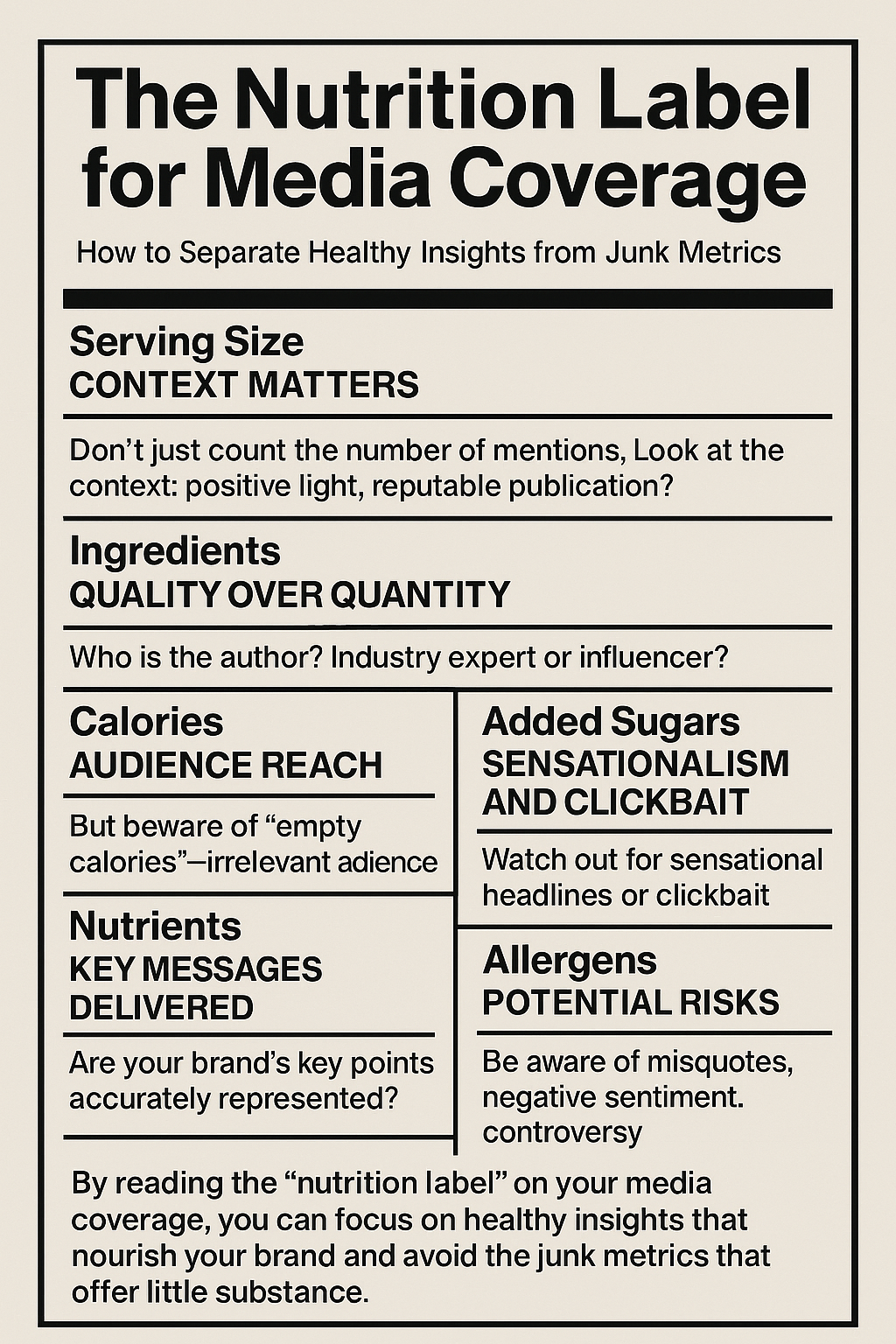
Reading the “nutrition label” on your media coverage, you can focus on healthy insights that nourish your brand and avoid the junk metrics that offer little substance. Make informed decisions, prioritize quality, and ensure your media strategy supports your long-term goals. Ready to move beyond vanity metrics? Learn more about Fullintel’s Strategic Media Analysis and discover how analyst-led intelligence delivers insights that actually drive decisions.